- 자녀 계획, 나이, 삶과 수명에 대한 인식 - WIN 다국가 조사 #노인 #젊은이 #노후
- 조사일 : 2025/02/25
- [GallupReport(20250807)_Population_WIN.pdf] 다운로드
● 2025년 8월 7일(목) 공개 | 문의: 02-3702-2571/2621/2622
자녀 계획, 나이, 삶과 수명에 대한 인식: WIN 다국가 조사
→ 한국+세계 조사 결과 파일 다운로드(PDF)
/ 세계 조사 개요
· 2024년 12월~2025년 2월 40개국 성인 총 35,515명 전화/온라인/면접조사(주제별 참여국 상이)
/ 한국 조사 개요
· 조사기간: 2025년 1월 16~24일
· 표본추출: 사회연구패널★에서 성·연령·지역별 층화 추출
(한국갤럽이 무선전화 RDD 방식으로 구축·운영하는 확률 기반 조사패널)
· 응답방식: 모바일조사(조사대상자에게 문자메시지 발송, 자기기입식 웹조사)
· 조사대상: 전국 만 19~79세 1,085명
· 표본오차: ±3.0%포인트(95% 신뢰수준)
· 문자 발송 대비 응답 완료율: 36.5%(총 2,973명 중 1,085명)
· 의뢰처: 한국갤럽-WIN 자체 조사
/ 조사 문항(아래 순서대로 질문)
→ 현재 자녀 여부와 향후 계획
→ 스스로 늙었다고/더 이상 젊지 않다고 느끼는 나이(자유응답)
→ 삶과 수명 관련 인식: 삶의 질과 수명, 노후 대비, 수명 연장, 건강장수(10점 척도)
→ (영문) WIN commentary
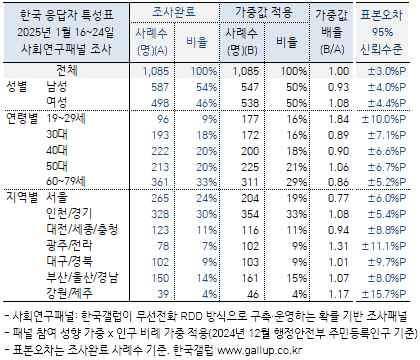
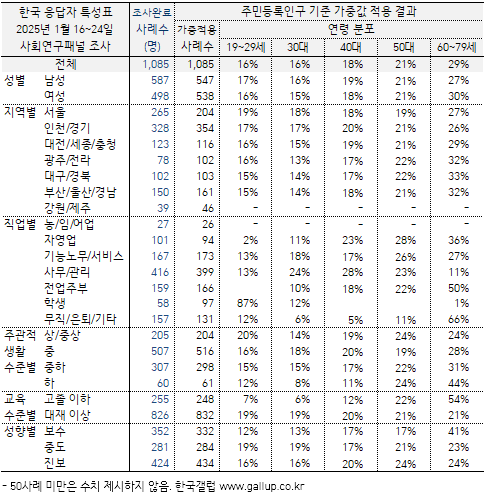
→ 한국 응답자 특성표
요약
[자녀 계획] 40개국 성인 중 16% '현재 자녀 없고 향후에도 가질 계획 없다'
· '현재 없고 향후 가질 것' 16%, '이미 있고 더 가질 것' 14%, '이미 있고 계획 없음' 46%
· 여성 기준 자녀 비희망자 많은 나라: 타이 38%, 일본·홍콩 30%, 핀란드 27%... 한국·독일 23%
[더 이상 젊지 않다고 느끼는 나이] 40개국 평균 41세, 한국 51세... 타이 26세
[스스로 늙었다고 느끼기 시작하는 나이] 40개국 평균 53세, 핀란드 71세... 모로코 36세
[삶과 수명] 40개국 시민 59% '삶의 질이 수명보다 더 중요하다'(이하 10점 척도, 8+9+10)
'나는 노후를 위해 대비 중이다/대비했다' 35%
'내 살아생전에 기술·의학 발전이 인간 수명을 크게 연장할 것이다' 42%
'나는 건강하게 오래 살 것을 낙관한다' 46%
· 가장 오래 젊다고 느끼는 한국인, 건강장수 낙관론자(26%) 비중은 참여국 평균 크게 밑돌아
조사 결과
────────────
자녀 계획
────────────
40개국 성인 중 16% '현재 자녀 없고 향후에도 가질 계획 없다'
- '현재 없고 향후 가질 것' 16%, '이미 있고 더 가질 것' 14%, '이미 있고 계획 없음' 46%
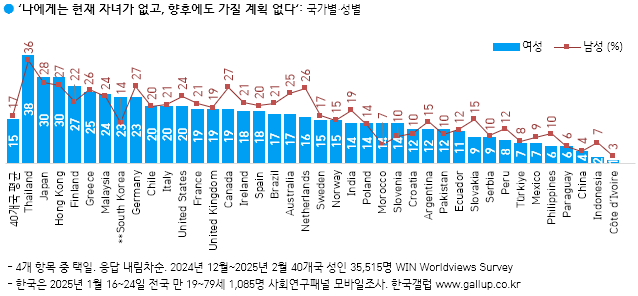
- 여성 기준 자녀 비희망자 많은 나라: 타이 38%, 일본·홍콩 30%, 핀란드 27%... 한국·독일 23%
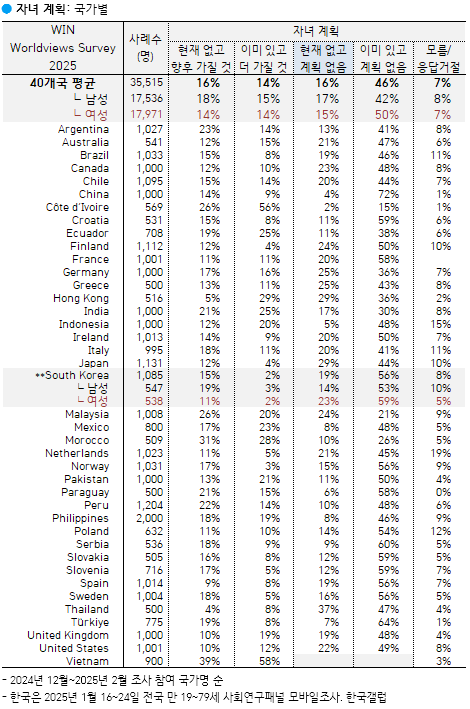
글로벌 조사 네트워크 WIN이 2024년 12월~2025년 2월 40개국 성인 35,515명에게 현재 자녀 여부와 향후 계획을 물었다. 그 결과 46%가 '이미 자녀가 있고 향후 더 가질 계획 없다'고 답했고, '이미 있고 더 가질 계획 있다' 14%, '현재 없고 향후 가질 계획이다' 16%, '현재 없고 향후에도 가질 계획 없다' 16%로 나타났다. 7%는 의견을 유보했다.
◎ 여기서 주목할 부분은 여러 국가의 저출생·고령화 현상 단면을 보여주는 무자녀 지향자, 즉 지금 자녀가 없고 앞으로도 가질 계획 없는 이들이다. 이번 조사에 참여한 40개국 중에서는 타이의 무자녀 지향자 비율이 37%로 가장 높았고, 일본·홍콩(29%), 그리스·독일(25%), 핀란드·말레이시아(24%), 캐나다(23%), 미국(22%)이 뒤이었다.
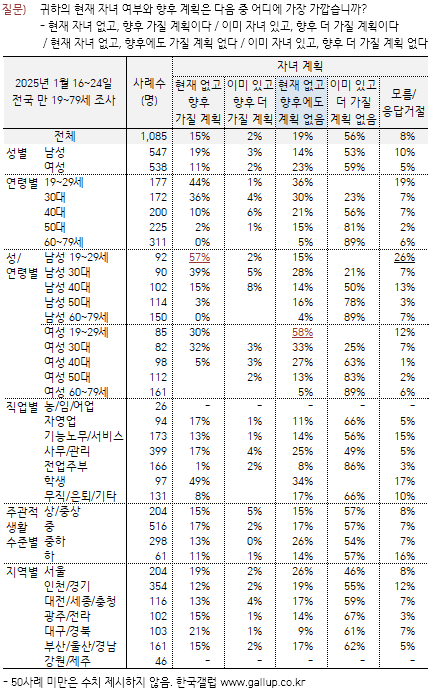
◎ 한국 조사는 2025년 1월 16~24일 전국 만 19~79세 1,085명을 대상으로 했다. 한국의 무자녀 지향자 비율은 19%로, 40개국 평균(16%)에 가깝지만 성별로 구분해서 보면 그 양상이 다르다. 한국 여성의 23%가 무자녀 지향자며, 특히 저연령일수록 두드러진다(20대 여성 58%, 30·40대 30% 내외, 60·70대 10% 내외). 한국 남성 중 무자녀 지향자는 14%로 여성보다 적고, 연령별 차이도 크지 않다. 과거 결혼과 양육 관련 조사에서도 젊은층의 성별 인식 차가 큰 것으로 파악된 바 있다(→ G2023).
────────────
젊음과 늙음의 경계 나이
────────────
/ 더 이상 젊지 않다고 느끼는 나이: 40개국 평균 41세, 한국 51세... 타이 26세
/ 스스로 늙었다고 느끼기 시작하는 나이: 40개국 평균 53세, 핀란드 71세... 모로코 36세
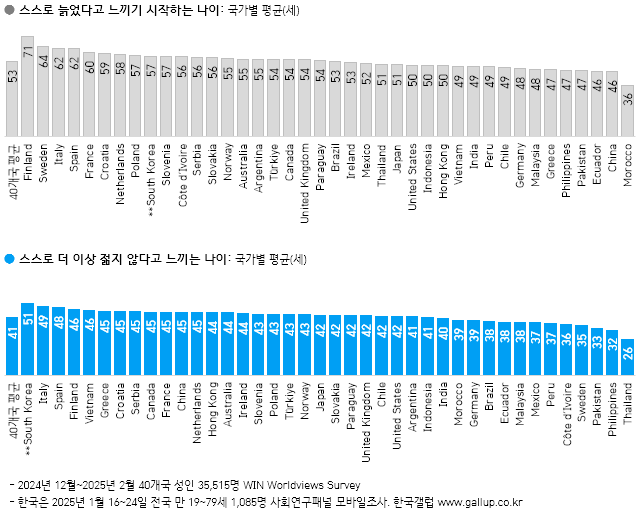
글로벌 조사 네트워크 WIN이 2024년 12월~2025년 2월 40개국 성인 35,515명에게 사람들이 스스로 늙었다고 느끼기 시작하는 나이와 더 이상 젊지 않다고 느끼는 나이를 각각 물었다(자유응답). 그 결과를 전체 응답의 중앙값(median) 기준으로 보면 더 이상 젊지 않다고 느끼는 나이는 40세(평균 41세), 늙었다고 느끼기 시작하는 나이는 50세(평균 53세)로 나타났다.
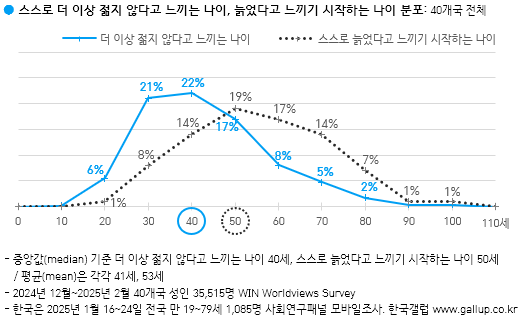
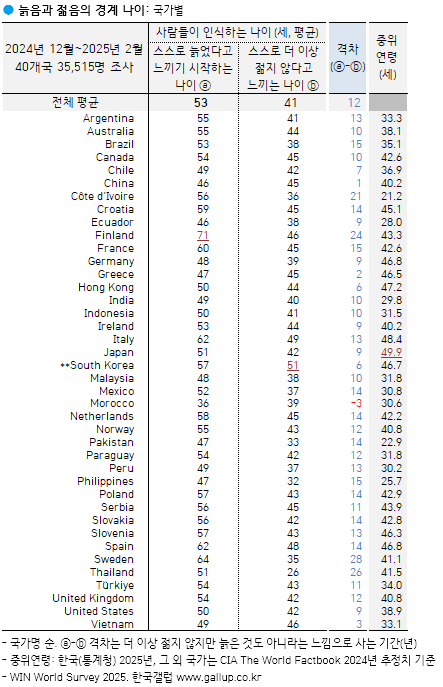
◎ 40개국 중 스스로 늙었다고 느끼기 시작하는 시기가 가장 늦은 나라는 핀란드(이하 모두 '평균' 기준, 71세), 스웨덴(64세), 이탈리아·스페인(62세), 프랑스(60세) 순, 그 시기가 가장 이른 나라는 모로코(36세), 중국·에콰도르(46세), 파키스탄·필리핀·그리스(47세) 순이다.
◎ 스스로 더 이상 젊지 않다고 느끼는 시기가 가장 늦은 나라는 한국(51세), 이탈리아(49세), 스페인(48세), 핀란드·베트남(46세) 순, 그 시기가 가장 이른 나라는 타이(26세), 필리핀(32세), 파키스탄(33세), 스웨덴(35세), 코트디부아르(36세) 순이다.
◎ 한국인이 스스로 늙었다고 느끼기 시작하는 때는 57세, 더 이상 젊지 않다고 느끼는 때는 51세로 40개국 평균보다 각각 4년, 10년 뒤늦었다. 우리 주변국인 일본·미국은 42세쯤 젊음이 멈추고 각각 51세·50세부터 늙었다고 답해 40개국 평균 수준이었다.
──
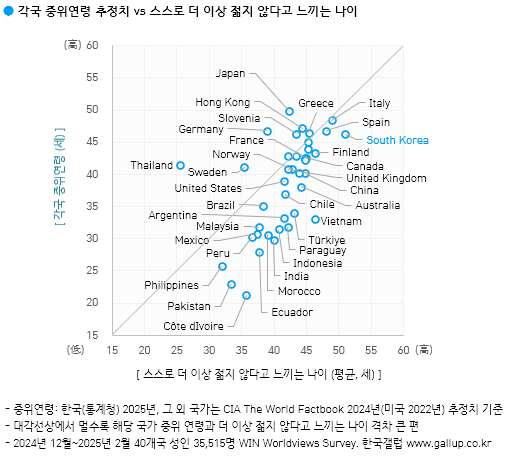
젊음이 멈추는 나이, 각국 중위연령 전후 10세 안팎
- 국가별 나이듦에 대한 생각, 관습, 사회경제적 여건 등에 따른 영향 추정
우리나라 중위연령(총인구를 연령순으로 나열할 때 정중앙에 있는 사람의 해당 연령)은 1975년 19.6세, 1985년 24.3세, 1995년 29.3세, 2005년 34.8세, 2015년 40.9세, 2025년 기준 46.7세다(→ 통계청).
◎ 국가별 젊음이 멈추는 나이는 대부분 자국 중위연령 전후 10세 안팎이지만, 일부 국가는 그 격차가 더 컸다. 예컨대 중위연령 21.2세인 코트디부아르에서는 젊음이 멈추는 나이를 36세로 높이 봤고, 중위연령 41.5세인 타이에서는 26세로 낮게 봤다. 이는 나이듦에 대한 생각, 관습, 사회경제적 여건, 의료 환경 등이 다른 데서 비롯한 차이로 추정된다.
◎ 중위연령 45세 이상 국가 중 젊음이 멈추는 나이를 가장 높게 답한 한국, 이탈리아, 스페인 등은 상대적으로 건강을 자부하는 사람이 많다는 공통점이 있다(→ G20240411).
──
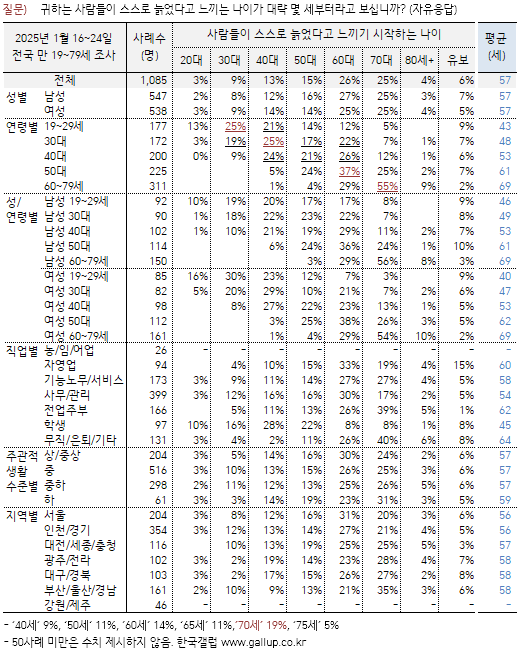
고연령일수록 늙음과 젊음의 경계 나이 상향
- 한국 세대별 나이 인식, 7년 전보다 양극화
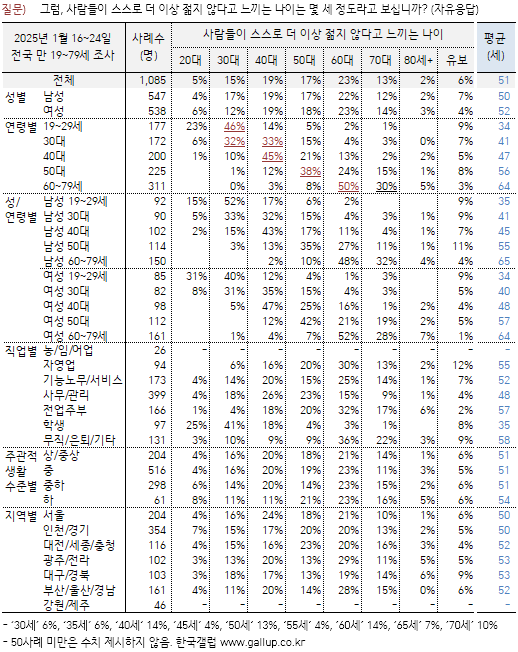
한국인은 다른 나라 사람들보다 가장 늦게까지 젊다는 느낌으로 산다. 하지만 세대별 인식 차가 두드러진다. 현재 20대는 스스로 늙었다고 느끼기 시작하는 나이를 43세, 40대는 53세, 60·70대는 69세로 봤다. 더 이상 젊지 않다고 느끼는 나이는 20대 34세, 40대 47세, 60·70대 64세다. 즉 고연령일수록 늙음과 젊음의 경계 나이가 높고, 기울기도 가팔라 양극화 경향을 띤다.
◎ 7년 전에는 20대와 60·70대의 기준점 차이가 이 정도로 크지 않았다: 2018년 늙었다고 느끼기 시작하는 나이 20대 54세, 60대+ 66세, 젊지 않다고 느끼는 나이 20대 47세, 60대+ 57세(→ G20190530).
────────────
삶과 수명
────────────
40개국 시민 59% '삶의 질이 수명보다 더 중요하다'(이하 10점 척도, 8+9+10)
- '건강하게 오래 살 것 낙관' 46%, '과학이 수명 연장할 것' 42%, '노후 대비 중/대비했다' 35%
- 가장 오래 젊다고 느끼는 한국인, 건강장수 낙관론자(26%) 비중은 참여국 평균 크게 밑돌아
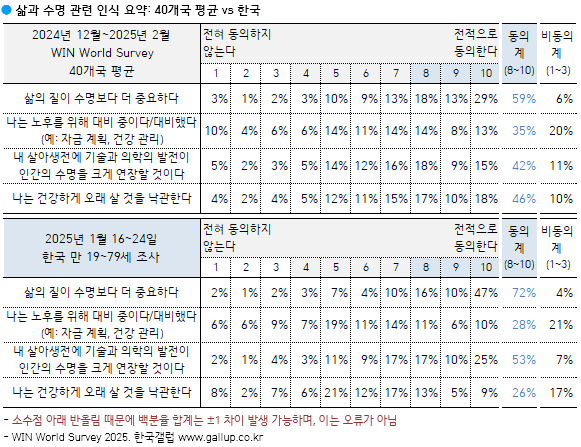
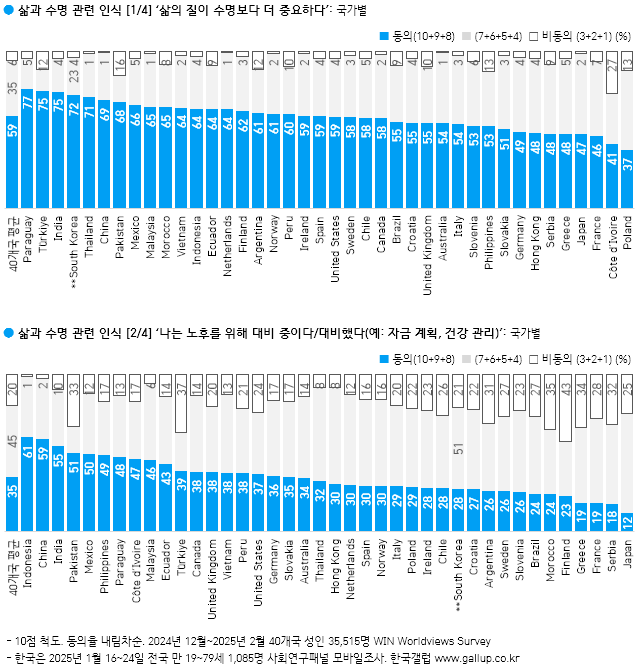
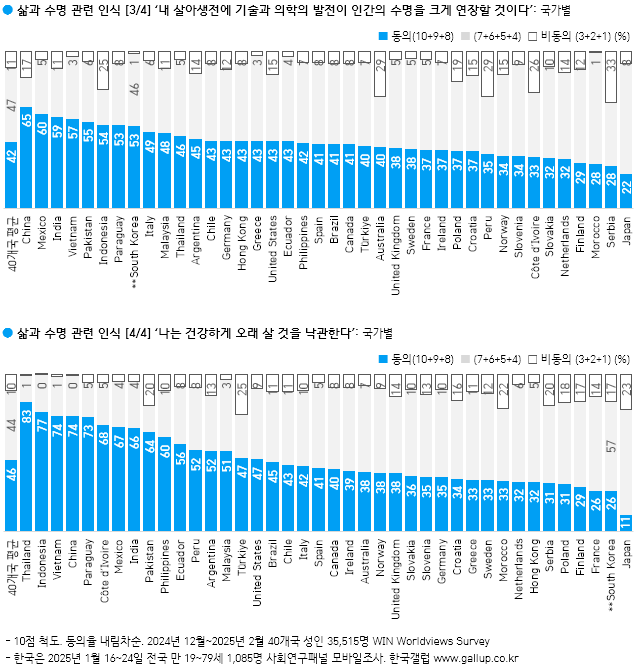
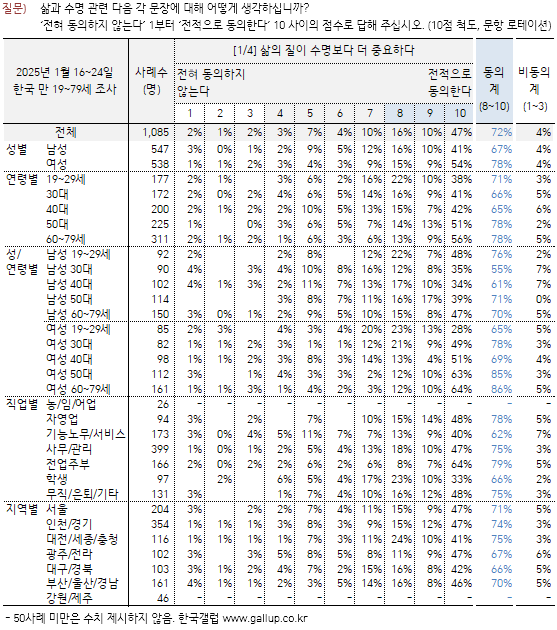
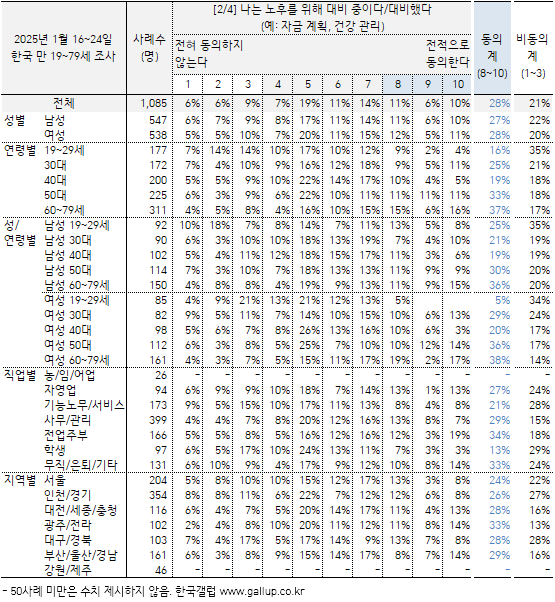
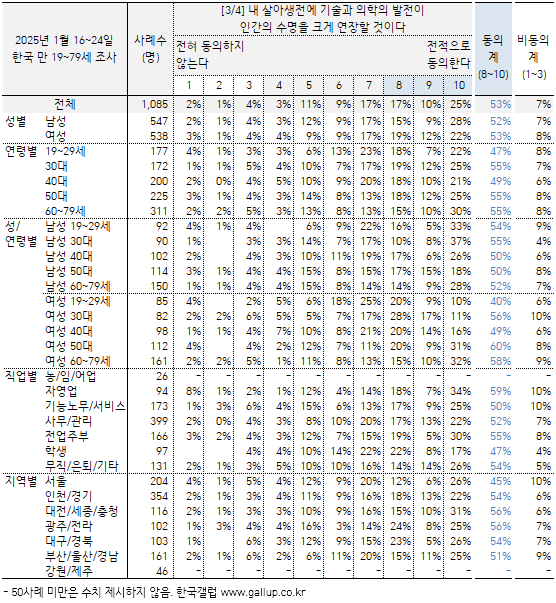
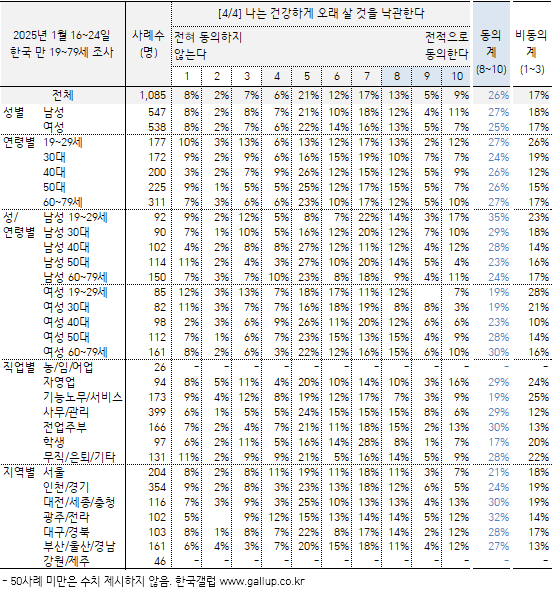
글로벌 조사 네트워크 WIN이 2024년 12월~2025년 2월 40개국 성인 35,515명에게 삶과 수명 관련 네 가지 주장을 제시하고 각각에 대한 동의 정도를 물었다(10점 척도: 분석 시 1~3점 응답을 '비동의', 8~10점을 '동의', 4~7점은 동의 여부가 분명하지 않은 '중간자(中間子)'로 구분). 그 결과, 조사에 참여한 40개국 시민 중 59%가 '삶의 질이 수명보다 더 중요하다'고 봤고, '건강하게 오래 살 것을 낙관한다'에 46%, '기술·의학 발전이 인간 수명을 크게 연장할 것이다'에 42%, '노후를 위해 대비 중이다/대비했다(예: 자금 계획, 건강 관리)'에 35%가 동의했다.
◎ 한국인은 '수명보다 삶의 질'(72%), '인간 수명 연장'(53%) 항목에는 상대적으로 높은 동의율을, '노후 대비'(28%)에는 낮은 동의율을 보였다. 특히 이번 조사에 참여한 40개국 시민 중 가장 오래 젊다고 느끼면서도 건강장수 낙관론자(26%) 비중은 참여국 평균을 크게 밑돌아, 준비되지 않은 노후에 대한 불안감이 엿보였다.
◎ 참고로 한국인이 스스로 늙었다고 느끼기 시작하는 나이는 57세지만, '노인, 노후 생활' 시작 나이는 65세로 조사됐다(평균, 2023년 2월). 자신의 노후 생계 부양자로 '본인' 60%,, '정부와 사회' 33%, '자녀들' 3% 순으로 꼽았고, 54%가 노후 생계유지에 대해 불안감을 표했으며, 77%는 국민연금 기금 고갈을 우려했다(→ 제529호).
──────────────────
People globally are reevaluating their plans
for health, aging, and parenthood
──────────────────
The Worldwide Independent Network of MR (WIN), the leading global association of independent market research and polling firms, has released new findings from its Worldviews Survey. This year’s survey captures the perspective and beliefs of 35,515 individuals across 40 countries. As we mark the World Population Day, the latest results offer a revealing picture of how the world is rethinking longevity, ageing, and family life. Tracking trends over six years, WIN has assessed and provided valuable insights into global progress.
Let’s dive into the findings:
Over half the world hopes to live long and well – but few are making plans for it
Globally, 59% of people say they value quality of life more than longevity. Women (61%) are more likely than men (57%) to prioritise quality over length of life. While 56% of young people prioritise quality of life, this rises to 62% among those aged 65 and over. Similarly, individuals with higher education levels are more likely to value quality: just 55% of those with basic education say so, compared to 63% of those with a Master or PhD. The countries where quality of life is most strongly prioritised include Paraguay (77%), Turkey (75%), and India (75%). In contrast, countries such as Poland (37%), Ivory Coast (41%), France (46%), Japan (47%), Greece (48%), Serbia (48%) and Hong Kong (48%) show more moderate or even lukewarm support for this view.
Despite this widespread belief in the importance of living well, only 35% of people globally say they are actively planning for ageing — through steps such as financial preparation or healthcare directives. Even among the elderly, only four in ten strongly agree that they’ve made such preparations. Interestingly, men are slightly more likely than women to report taking action (37% vs. 34%).
Planning is most common in Indonesia (61%), China (59%), India (55%), and Pakistan (51%) — countries where awareness around ageing appears to translate more readily into action. On the other hand, Japan (12%), Serbia (18%), France (19%), and Greece (19%) show the lowest levels of preparation.
People globally are more optimistic for a longer life
Nearly half of the global population (46%) express optimism about living a long and healthy life. However, this hopeful outlook tends to decline with age — from 49% among 18- to 34-year-olds to just 42% among those aged 65 and above. A similar trend emerges with education: 53% of those with basic education are optimistic about their longevity, compared to 46% of those with higher education.
Attitudes also vary widely by country. Optimism is highest in Thailand (83%), Indonesia (77%), Vietnam (74%), China (74%) and Paraguay (73%). In contrast, populations in Japan (11%), South Korea (26%), and France (26%) are far more sceptical about the prospect of long, healthy lives.
Technology and medical innovation are widely seen as key contributors to longer life expectancy. Four in ten people globally believe advancements in these fields will significantly extend human life within their lifetime — a belief that grows stronger with higher levels of education. Countries where this optimism is especially high including China (65%), Mexico (60%), India (59%), and Vietnam (57%). Meanwhile, more tempered views are found in Japan (22%), Serbia (28%), Morocco (28%), and Finland (29%).
Cultural attitudes are shaping when the world feels old
Since 2018, people have been feeling younger for less time and older earlier. In 2025, the average age at which people say they stop feeling young is 41 (down from 44 in 2018), while the age they start feeling old has dropped slightly to 53 (from 55 in 2018).
There are wide regional and national variations in perceptions of aging. In the MENA region, people begin to feel old the earliest, at an average age of 48, whereas Europeans feel old the latest, at 58. At the national level, Finland reports the latest onset of feeling old at 71, followed by Sweden at 64. In contrast, people in Morocco (36), China (46), and Ecuador (46) report feeling old before reaching 50.
Conversely, national-level data reveals striking differences in when people stop feeling young, even within the same region. In Asia, for example, South Koreans report feeling young until 51, while Thais stop feeling young at just 26. In Europe, some countries report feeling young until their late 40s (e.g. Italy at 49, Spain at 48) compared to just 35 in Sweden. These contrasts underscore that perceptions of youth and aging are shaped less by geography alone and more by specific cultural and societal norms at the national level.
A generation rethinking parenthood: a quarter of young people don’t want children
Globally, 16% of people do not have children and have no plans to. Amongst young adults aged 18–24, that figure rises to 22%, with strong correlations to education levels. The trend is particularly pronounced amongst women: only 10% of women with basic education fall into this category, compared to 20% of women with a Master's or PhD. A similar pattern is seen in men, though less steep – 9% of men with basic education report no intention of having children, rising to 17% amongst those with secondary education or higher.
Regionally, the trend is strongest in Europe (18%), followed by the Americas and APAC (15%). Yet national variations are stark: in Thailand, 38% of women and 36% of men say they don’t plan to have children – the highest globally. In contrast, in Vietnam, virtually no one without children reports planning to remain child-free, followed by Côte d’Ivoire at only 2% for women and 3% for men.
Richard Colwell, President of WIN International Association notes:
“Around the world, people are thinking deeply about how they age, what it means to live well, and whether parenthood is part of that journey. The findings point to a complex and evolving portrait of modern life, and WIN hopes that this can spark meaningful conversations amongst policymakers, healthcare providers, and communities about how to better support people in making informed, empowered choices about their future”.
───
한국 응답자 특성표
| ● 데일리 오피니언은 작년부터 조사 빈도를 조금 줄였습니다. 매주 화~목 중 공휴일이 포함되어 조사 기간 사흘이 확보되지 않을 때는 조사를 쉬고, 명절과 연말연시에 이어 여름 휴가철 휴지기를 도입했습니다. 조사의 질적 제고와 시민의 참여 편의를 고려한 방편이니 부디 너른 양해 바랍니다. 올여름은 3주간(7/21~8/8) 데일리 조사를 쉽니다. 그동안 미공개 결과를 전하며, 8월 15일(금)에 제630호를 공개합니다. → 데일리 조사 & 한국갤럽 연간 휴무 일정 ● 전 대륙에서 시장조사와 여론조사를 하는 글로벌 네트워크 WIN(Worldwide Independent Network of Market Research)은 매년 건강, 환경, IT 등 여러 분야 현안에 관해 다국가 조사를 하고 있습니다. WIN Worldviews Survey 2025는 2024년 12월~2025년 2월 40개국 성인을 대상으로 했습니다. 〈의약품과 백신〉 〈성평등(Gender Equality)〉 〈기후·환경과 기업의 사회적 책임〉 〈가계 형편〉에 이어 오늘은 〈자녀 계획, 나이, 삶과 수명〉에 대한 인식을 전합니다. |
자녀 계획, 나이, 삶과 수명에 대한 인식: WIN 다국가 조사
→ 한국+세계 조사 결과 파일 다운로드(PDF)
/ 세계 조사 개요
· 2024년 12월~2025년 2월 40개국 성인 총 35,515명 전화/온라인/면접조사(주제별 참여국 상이)
/ 한국 조사 개요
· 조사기간: 2025년 1월 16~24일
· 표본추출: 사회연구패널★에서 성·연령·지역별 층화 추출
(한국갤럽이 무선전화 RDD 방식으로 구축·운영하는 확률 기반 조사패널)
· 응답방식: 모바일조사(조사대상자에게 문자메시지 발송, 자기기입식 웹조사)
· 조사대상: 전국 만 19~79세 1,085명
· 표본오차: ±3.0%포인트(95% 신뢰수준)
· 문자 발송 대비 응답 완료율: 36.5%(총 2,973명 중 1,085명)
· 의뢰처: 한국갤럽-WIN 자체 조사
/ 조사 문항(아래 순서대로 질문)
→ 현재 자녀 여부와 향후 계획
→ 스스로 늙었다고/더 이상 젊지 않다고 느끼는 나이(자유응답)
→ 삶과 수명 관련 인식: 삶의 질과 수명, 노후 대비, 수명 연장, 건강장수(10점 척도)
→ (영문) WIN commentary
→ 한국 응답자 특성표
요약
[자녀 계획] 40개국 성인 중 16% '현재 자녀 없고 향후에도 가질 계획 없다'
· '현재 없고 향후 가질 것' 16%, '이미 있고 더 가질 것' 14%, '이미 있고 계획 없음' 46%
· 여성 기준 자녀 비희망자 많은 나라: 타이 38%, 일본·홍콩 30%, 핀란드 27%... 한국·독일 23%
[더 이상 젊지 않다고 느끼는 나이] 40개국 평균 41세, 한국 51세... 타이 26세
[스스로 늙었다고 느끼기 시작하는 나이] 40개국 평균 53세, 핀란드 71세... 모로코 36세
[삶과 수명] 40개국 시민 59% '삶의 질이 수명보다 더 중요하다'(이하 10점 척도, 8+9+10)
'나는 노후를 위해 대비 중이다/대비했다' 35%
'내 살아생전에 기술·의학 발전이 인간 수명을 크게 연장할 것이다' 42%
'나는 건강하게 오래 살 것을 낙관한다' 46%
· 가장 오래 젊다고 느끼는 한국인, 건강장수 낙관론자(26%) 비중은 참여국 평균 크게 밑돌아
조사 결과
────────────
자녀 계획
────────────
40개국 성인 중 16% '현재 자녀 없고 향후에도 가질 계획 없다'
- '현재 없고 향후 가질 것' 16%, '이미 있고 더 가질 것' 14%, '이미 있고 계획 없음' 46%
- 여성 기준 자녀 비희망자 많은 나라: 타이 38%, 일본·홍콩 30%, 핀란드 27%... 한국·독일 23%
글로벌 조사 네트워크 WIN이 2024년 12월~2025년 2월 40개국 성인 35,515명에게 현재 자녀 여부와 향후 계획을 물었다. 그 결과 46%가 '이미 자녀가 있고 향후 더 가질 계획 없다'고 답했고, '이미 있고 더 가질 계획 있다' 14%, '현재 없고 향후 가질 계획이다' 16%, '현재 없고 향후에도 가질 계획 없다' 16%로 나타났다. 7%는 의견을 유보했다.
◎ 여기서 주목할 부분은 여러 국가의 저출생·고령화 현상 단면을 보여주는 무자녀 지향자, 즉 지금 자녀가 없고 앞으로도 가질 계획 없는 이들이다. 이번 조사에 참여한 40개국 중에서는 타이의 무자녀 지향자 비율이 37%로 가장 높았고, 일본·홍콩(29%), 그리스·독일(25%), 핀란드·말레이시아(24%), 캐나다(23%), 미국(22%)이 뒤이었다.
◎ 한국 조사는 2025년 1월 16~24일 전국 만 19~79세 1,085명을 대상으로 했다. 한국의 무자녀 지향자 비율은 19%로, 40개국 평균(16%)에 가깝지만 성별로 구분해서 보면 그 양상이 다르다. 한국 여성의 23%가 무자녀 지향자며, 특히 저연령일수록 두드러진다(20대 여성 58%, 30·40대 30% 내외, 60·70대 10% 내외). 한국 남성 중 무자녀 지향자는 14%로 여성보다 적고, 연령별 차이도 크지 않다. 과거 결혼과 양육 관련 조사에서도 젊은층의 성별 인식 차가 큰 것으로 파악된 바 있다(→ G2023).
────────────
젊음과 늙음의 경계 나이
────────────
/ 더 이상 젊지 않다고 느끼는 나이: 40개국 평균 41세, 한국 51세... 타이 26세
/ 스스로 늙었다고 느끼기 시작하는 나이: 40개국 평균 53세, 핀란드 71세... 모로코 36세
글로벌 조사 네트워크 WIN이 2024년 12월~2025년 2월 40개국 성인 35,515명에게 사람들이 스스로 늙었다고 느끼기 시작하는 나이와 더 이상 젊지 않다고 느끼는 나이를 각각 물었다(자유응답). 그 결과를 전체 응답의 중앙값(median) 기준으로 보면 더 이상 젊지 않다고 느끼는 나이는 40세(평균 41세), 늙었다고 느끼기 시작하는 나이는 50세(평균 53세)로 나타났다.
◎ 40개국 중 스스로 늙었다고 느끼기 시작하는 시기가 가장 늦은 나라는 핀란드(이하 모두 '평균' 기준, 71세), 스웨덴(64세), 이탈리아·스페인(62세), 프랑스(60세) 순, 그 시기가 가장 이른 나라는 모로코(36세), 중국·에콰도르(46세), 파키스탄·필리핀·그리스(47세) 순이다.
◎ 스스로 더 이상 젊지 않다고 느끼는 시기가 가장 늦은 나라는 한국(51세), 이탈리아(49세), 스페인(48세), 핀란드·베트남(46세) 순, 그 시기가 가장 이른 나라는 타이(26세), 필리핀(32세), 파키스탄(33세), 스웨덴(35세), 코트디부아르(36세) 순이다.
◎ 한국인이 스스로 늙었다고 느끼기 시작하는 때는 57세, 더 이상 젊지 않다고 느끼는 때는 51세로 40개국 평균보다 각각 4년, 10년 뒤늦었다. 우리 주변국인 일본·미국은 42세쯤 젊음이 멈추고 각각 51세·50세부터 늙었다고 답해 40개국 평균 수준이었다.
──
젊음이 멈추는 나이, 각국 중위연령 전후 10세 안팎
- 국가별 나이듦에 대한 생각, 관습, 사회경제적 여건 등에 따른 영향 추정
우리나라 중위연령(총인구를 연령순으로 나열할 때 정중앙에 있는 사람의 해당 연령)은 1975년 19.6세, 1985년 24.3세, 1995년 29.3세, 2005년 34.8세, 2015년 40.9세, 2025년 기준 46.7세다(→ 통계청).
◎ 국가별 젊음이 멈추는 나이는 대부분 자국 중위연령 전후 10세 안팎이지만, 일부 국가는 그 격차가 더 컸다. 예컨대 중위연령 21.2세인 코트디부아르에서는 젊음이 멈추는 나이를 36세로 높이 봤고, 중위연령 41.5세인 타이에서는 26세로 낮게 봤다. 이는 나이듦에 대한 생각, 관습, 사회경제적 여건, 의료 환경 등이 다른 데서 비롯한 차이로 추정된다.
◎ 중위연령 45세 이상 국가 중 젊음이 멈추는 나이를 가장 높게 답한 한국, 이탈리아, 스페인 등은 상대적으로 건강을 자부하는 사람이 많다는 공통점이 있다(→ G20240411).
──
고연령일수록 늙음과 젊음의 경계 나이 상향
- 한국 세대별 나이 인식, 7년 전보다 양극화
한국인은 다른 나라 사람들보다 가장 늦게까지 젊다는 느낌으로 산다. 하지만 세대별 인식 차가 두드러진다. 현재 20대는 스스로 늙었다고 느끼기 시작하는 나이를 43세, 40대는 53세, 60·70대는 69세로 봤다. 더 이상 젊지 않다고 느끼는 나이는 20대 34세, 40대 47세, 60·70대 64세다. 즉 고연령일수록 늙음과 젊음의 경계 나이가 높고, 기울기도 가팔라 양극화 경향을 띤다.
◎ 7년 전에는 20대와 60·70대의 기준점 차이가 이 정도로 크지 않았다: 2018년 늙었다고 느끼기 시작하는 나이 20대 54세, 60대+ 66세, 젊지 않다고 느끼는 나이 20대 47세, 60대+ 57세(→ G20190530).
────────────
삶과 수명
────────────
40개국 시민 59% '삶의 질이 수명보다 더 중요하다'(이하 10점 척도, 8+9+10)
- '건강하게 오래 살 것 낙관' 46%, '과학이 수명 연장할 것' 42%, '노후 대비 중/대비했다' 35%
- 가장 오래 젊다고 느끼는 한국인, 건강장수 낙관론자(26%) 비중은 참여국 평균 크게 밑돌아
글로벌 조사 네트워크 WIN이 2024년 12월~2025년 2월 40개국 성인 35,515명에게 삶과 수명 관련 네 가지 주장을 제시하고 각각에 대한 동의 정도를 물었다(10점 척도: 분석 시 1~3점 응답을 '비동의', 8~10점을 '동의', 4~7점은 동의 여부가 분명하지 않은 '중간자(中間子)'로 구분). 그 결과, 조사에 참여한 40개국 시민 중 59%가 '삶의 질이 수명보다 더 중요하다'고 봤고, '건강하게 오래 살 것을 낙관한다'에 46%, '기술·의학 발전이 인간 수명을 크게 연장할 것이다'에 42%, '노후를 위해 대비 중이다/대비했다(예: 자금 계획, 건강 관리)'에 35%가 동의했다.
◎ 한국인은 '수명보다 삶의 질'(72%), '인간 수명 연장'(53%) 항목에는 상대적으로 높은 동의율을, '노후 대비'(28%)에는 낮은 동의율을 보였다. 특히 이번 조사에 참여한 40개국 시민 중 가장 오래 젊다고 느끼면서도 건강장수 낙관론자(26%) 비중은 참여국 평균을 크게 밑돌아, 준비되지 않은 노후에 대한 불안감이 엿보였다.
◎ 참고로 한국인이 스스로 늙었다고 느끼기 시작하는 나이는 57세지만, '노인, 노후 생활' 시작 나이는 65세로 조사됐다(평균, 2023년 2월). 자신의 노후 생계 부양자로 '본인' 60%,, '정부와 사회' 33%, '자녀들' 3% 순으로 꼽았고, 54%가 노후 생계유지에 대해 불안감을 표했으며, 77%는 국민연금 기금 고갈을 우려했다(→ 제529호).
──────────────────
People globally are reevaluating their plans
for health, aging, and parenthood
──────────────────
The Worldwide Independent Network of MR (WIN), the leading global association of independent market research and polling firms, has released new findings from its Worldviews Survey. This year’s survey captures the perspective and beliefs of 35,515 individuals across 40 countries. As we mark the World Population Day, the latest results offer a revealing picture of how the world is rethinking longevity, ageing, and family life. Tracking trends over six years, WIN has assessed and provided valuable insights into global progress.
Let’s dive into the findings:
Over half the world hopes to live long and well – but few are making plans for it
Globally, 59% of people say they value quality of life more than longevity. Women (61%) are more likely than men (57%) to prioritise quality over length of life. While 56% of young people prioritise quality of life, this rises to 62% among those aged 65 and over. Similarly, individuals with higher education levels are more likely to value quality: just 55% of those with basic education say so, compared to 63% of those with a Master or PhD. The countries where quality of life is most strongly prioritised include Paraguay (77%), Turkey (75%), and India (75%). In contrast, countries such as Poland (37%), Ivory Coast (41%), France (46%), Japan (47%), Greece (48%), Serbia (48%) and Hong Kong (48%) show more moderate or even lukewarm support for this view.
Despite this widespread belief in the importance of living well, only 35% of people globally say they are actively planning for ageing — through steps such as financial preparation or healthcare directives. Even among the elderly, only four in ten strongly agree that they’ve made such preparations. Interestingly, men are slightly more likely than women to report taking action (37% vs. 34%).
Planning is most common in Indonesia (61%), China (59%), India (55%), and Pakistan (51%) — countries where awareness around ageing appears to translate more readily into action. On the other hand, Japan (12%), Serbia (18%), France (19%), and Greece (19%) show the lowest levels of preparation.
People globally are more optimistic for a longer life
Nearly half of the global population (46%) express optimism about living a long and healthy life. However, this hopeful outlook tends to decline with age — from 49% among 18- to 34-year-olds to just 42% among those aged 65 and above. A similar trend emerges with education: 53% of those with basic education are optimistic about their longevity, compared to 46% of those with higher education.
Attitudes also vary widely by country. Optimism is highest in Thailand (83%), Indonesia (77%), Vietnam (74%), China (74%) and Paraguay (73%). In contrast, populations in Japan (11%), South Korea (26%), and France (26%) are far more sceptical about the prospect of long, healthy lives.
Technology and medical innovation are widely seen as key contributors to longer life expectancy. Four in ten people globally believe advancements in these fields will significantly extend human life within their lifetime — a belief that grows stronger with higher levels of education. Countries where this optimism is especially high including China (65%), Mexico (60%), India (59%), and Vietnam (57%). Meanwhile, more tempered views are found in Japan (22%), Serbia (28%), Morocco (28%), and Finland (29%).
Cultural attitudes are shaping when the world feels old
Since 2018, people have been feeling younger for less time and older earlier. In 2025, the average age at which people say they stop feeling young is 41 (down from 44 in 2018), while the age they start feeling old has dropped slightly to 53 (from 55 in 2018).
There are wide regional and national variations in perceptions of aging. In the MENA region, people begin to feel old the earliest, at an average age of 48, whereas Europeans feel old the latest, at 58. At the national level, Finland reports the latest onset of feeling old at 71, followed by Sweden at 64. In contrast, people in Morocco (36), China (46), and Ecuador (46) report feeling old before reaching 50.
Conversely, national-level data reveals striking differences in when people stop feeling young, even within the same region. In Asia, for example, South Koreans report feeling young until 51, while Thais stop feeling young at just 26. In Europe, some countries report feeling young until their late 40s (e.g. Italy at 49, Spain at 48) compared to just 35 in Sweden. These contrasts underscore that perceptions of youth and aging are shaped less by geography alone and more by specific cultural and societal norms at the national level.
A generation rethinking parenthood: a quarter of young people don’t want children
Globally, 16% of people do not have children and have no plans to. Amongst young adults aged 18–24, that figure rises to 22%, with strong correlations to education levels. The trend is particularly pronounced amongst women: only 10% of women with basic education fall into this category, compared to 20% of women with a Master's or PhD. A similar pattern is seen in men, though less steep – 9% of men with basic education report no intention of having children, rising to 17% amongst those with secondary education or higher.
Regionally, the trend is strongest in Europe (18%), followed by the Americas and APAC (15%). Yet national variations are stark: in Thailand, 38% of women and 36% of men say they don’t plan to have children – the highest globally. In contrast, in Vietnam, virtually no one without children reports planning to remain child-free, followed by Côte d’Ivoire at only 2% for women and 3% for men.
Richard Colwell, President of WIN International Association notes:
“Around the world, people are thinking deeply about how they age, what it means to live well, and whether parenthood is part of that journey. The findings point to a complex and evolving portrait of modern life, and WIN hopes that this can spark meaningful conversations amongst policymakers, healthcare providers, and communities about how to better support people in making informed, empowered choices about their future”.
───
한국 응답자 특성표