- 2026년 새해 전망 - Gallup International 다국가 조사 #행복감
- 조사일 : 2025/12/22
- [GallupReport(20260212)_EOY_GIA.pdf] 다운로드
● 2026년 2월 12일(목) 공개 | 문의: 02-3702-2571/2621/2622
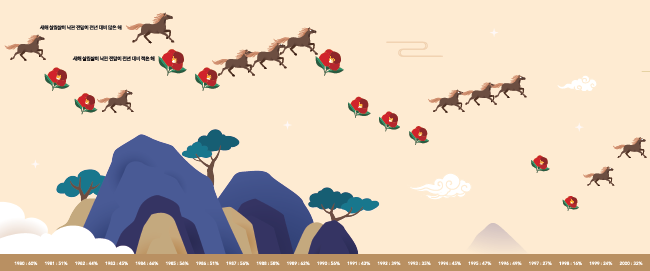
→ 최근 6년 연하장: 2026년 | 2025년 | 2024년 | 2023년 | 2022년 | 2021년
2026년 새해 전망: Gallup International 다국가 조사
→ 한국 조사 결과 파일 다운로드(PDF)
→ 60개국 조사 결과 전체 보기 & 파일
/ 세계 조사 개요
- 2025년 10~12월 60개국 성인 총 59,636명 전화/온라인/면접조사(주제별 참여국 상이)
/ 한국 조사 개요
· 조사기간: 2025년 11월 11~28일
· 표본추출: 층화 집락 확률 비례 추출
· 응답방식: 면접조사원 인터뷰(CAPI)
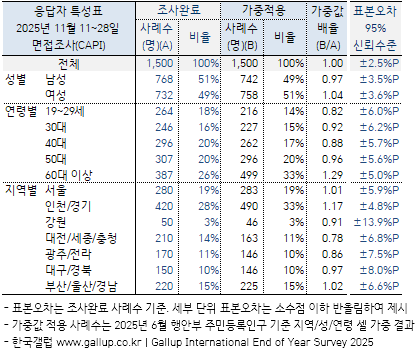
· 조사대상: 전국(제주 제외) 만 19세 이상 1,500명
· 표본오차: ±2.5%포인트(95% 신뢰수준)
· 응답률: 34.5%(총 접촉 4,348명 중 1,500명 응답 완료)
· 의뢰처: 한국갤럽-Gallup International 자체 조사
/ 조사 항목(화살표(→) 옆 단어 클릭하면 해당 위치로 이동)
→ 60개국 2026년 새해 전망 | 자국 경제(경기) 전망 | 세계 정세 전망
→ 한국인의 새해 전망 47년간 추이: 경기/살림살이/실업자/노사관계/국제관계
→ 한국인의 주관적 행복감
→ (영문) Gallup International commentary
→ 한국 응답자 특성표
요약
[60개국 2026년 새해 전망] 낙관 37%, 비관 25%, 불변 31%
[새해 자국 경제] '좋아질 것' 24%, '나빠질 것' 40%, '비슷할 것' 31%
· 한국: 전반적 삶, 세계 정세 낙관론 60개국 평균 크게 밑돌아
[새해 세계 정세] '평화로울 것' 26%, '혼란스러울 것' 40%, 불변 28%
[한국] 경기, 살림살이, 실업, 노사, 국제관계 전반에 걸쳐 전년 대비 비관론 완화
· 주관적 행복감 순지수: 20~40대 여성·30대 남성 높은 편, 60대 남성 가장 낮아
조사 결과
────────────
60개국 2026년 새해 전망
────────────
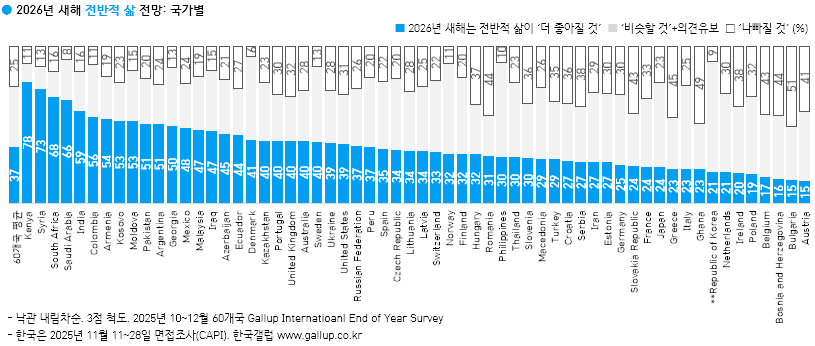
'좋아질 것' 37%, '나빠질 것' 25%, '비슷할 것' 31%
2025년 10~12월 갤럽 인터내셔널이 세계 60개국 성인 59,636명에게 2026년 새해 전망을 물은 결과 '좋아질 것' 37%, '나빠질 것' 25%, '비슷할 것' 31%로 낙관론이 비관론을 앞섰다. 1년 전과 비교하면 낙관론이 4%포인트 줄고, 비관론은 1%포인트 늘었다.
◎ 새해 전망을 가장 밝게 보는 나라는 케냐로, 78%가 '2026년이 2025년보다 좋아질 것'이라고 답했다. 그다음은 시리아(73%), 남아프리카공화국(68%), 사우디아라비아(66%), 인도(59%), 콜롬비아(56%), 아르메니아(54%) 순이다. 한편, 우리 주변국 중에서는 미국(39%)과 러시아(37%)가 60개국 평균 수준, 일본(24%)은 우리나라(21%)와 함께 하위권에 속했다.
────────────
60개국 새해 자국 경제 전망
────────────
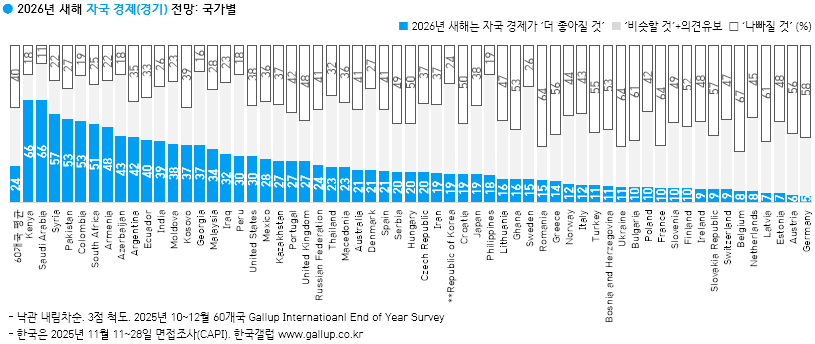
'좋아질 것' 24%, '나빠질 것' 40%, '비슷할 것' 31%
2026년 새해 자국 경제(경기) 전망에 관해서는 '좋아질 것' 24%, '나빠질 것' 40%, '비슷할 것' 31%로 비관론이 낙관론을 앞섰고, 격차도 전년보다 커졌다. 1년 전과 비교하면 경기 낙관론이 5%포인트 줄고, 그만큼 비관론이 늘었다.
◎ 새해 자국 경기를 가장 낙관적으로 보는 나라는 케냐와 사우디아라비아로, 각각 66%가 '좋아질 것'이라고 답했다. 그다음은 시리아(57%), 파키스탄·콜롬비아(53%), 남아프리카공화국(51%) 순이다. 이외 주요국 낙관론은 세계 평균과 비슷하거나 그보다 뒤졌다: 미국 30%, 러시아 24%, 한국·일본 19%, 독일 5%.
◎ 이번 조사에 참여한 60개 나라 중 자국 경기 낙관론이 비관론보다 10%포인트 이상 많은 나라는 12개국, 반대로 비관론이 낙관론보다 10%포인트 이상 많은 나라는 37개국이다.
────────────
60개국 새해 세계 정세 전망
────────────
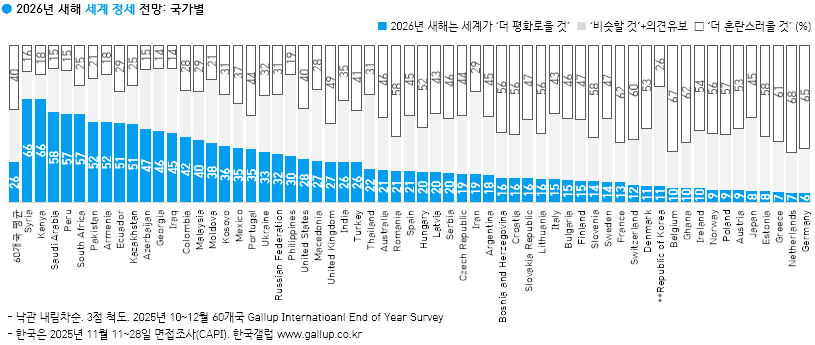
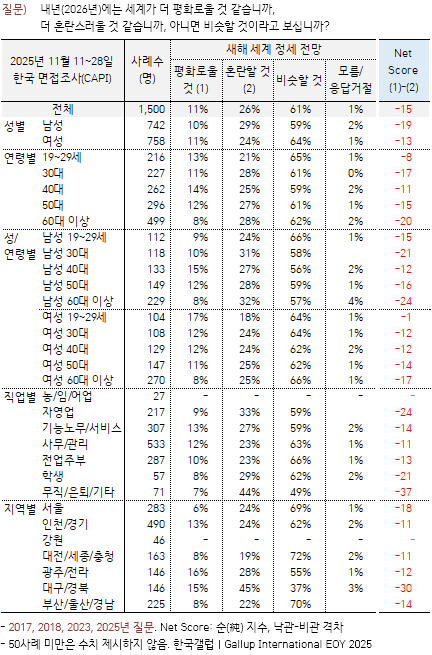
'세계가 더 평화로울 것' 26%, '더 혼란스러울 것' 40%, '비슷할 것' 28%
2026년 새해 세계 정세에 관해서는 26%가 '더 평화로울 것', 40%가 '더 혼란스러울 것', '비슷할 것' 28%로 비관론이 낙관론을 앞섰다. 가장 낙관적인 나라는 시리아와 케냐로, 새해 세계가 '더 평화로울 것'이란 응답이 각각 66%를 차지했다. 사우디아라비아(58%), 페루·남아프리카공화국(57%), 파키스탄·아르메니아(52%), 에콰도르·카자흐스탄(51%) 등에서도 낙관론이 50%를 넘었다.
◎ 세계 정세 비관론이 많은 나라는 네덜란드(68%), 벨기에(67%), 독일(65%), 가나·프랑스(62%) 등 유럽 국가가 다수를 차지한다. 그러나 2022년 2월부터 지속 중인 러시아-우크라이나 전쟁 당사국 두 나라는 주변 유럽 국가들보다 오히려 덜 비관적이다(지난 2023년 조사에서도 그랬다).
────────────
한국인의 새해 전망: 경기/살림살이/실업자/노사관계/국제관계
────────────
─
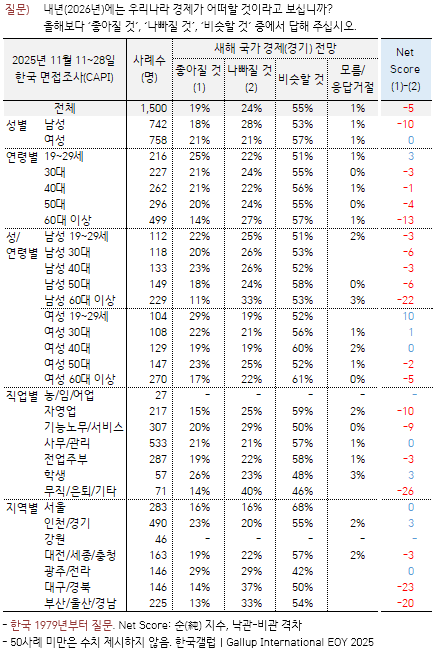
한국인의 2026년 새해 국가 경제 전망:
'좋아질 것' 19%, '나빠질 것' 24%, '비슷할 것' 55%
- 경기 낙관론 전년 대비 10%포인트 증가, 비관론 23%포인트 감소
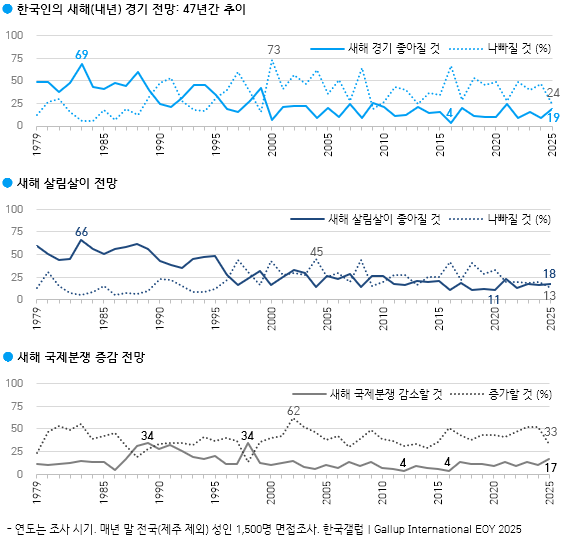
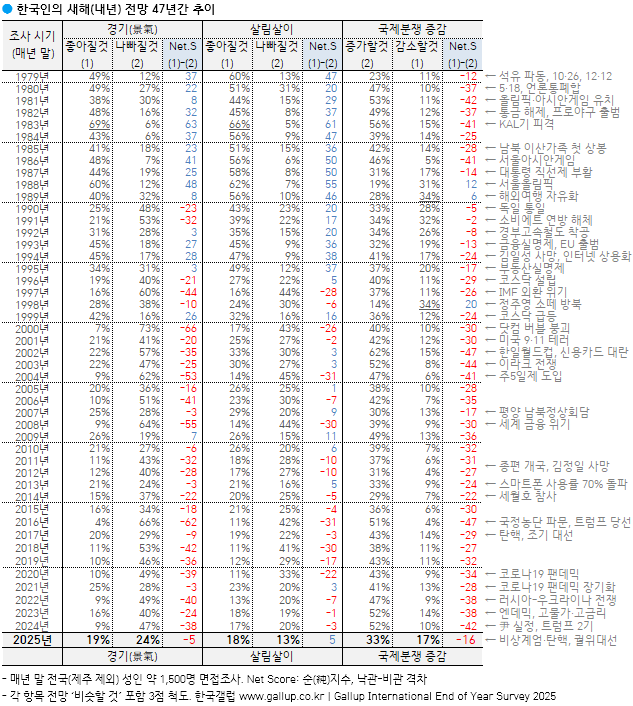
한국갤럽이 2025년 11월 11~28일 전국(제주 제외)의 만 19세 이상 1,500명에게 새해 우리나라 경제가 어떠할 것이라고 보는지 물었다. 그 결과, 한국 성인 중 19%가 '좋아질 것', 24%는 '나빠질 것', 55%는 '비슷할 것'이라고 답했다. 새해 경기 낙관론은 전년 대비 10%포인트 증가, 비관론은 23%포인트 감소했다.
◎ 2022년 초 러시아·우크라이나 전쟁에서 비롯한 에너지난과 각국의 급격한 재정 긴축 기조, 국내 부동산 거래 급감과 시세 하락 등은 향후 장기적 경기 침체의 전조로 해석된 바 있다. 고금리·고물가 현상은 지금까지도 이어지고 있으나, 2024년 11월 비상계엄 사태 직전 실각 위기의 윤석열 정부 당시와 비교하면 2025년 11월은 새 정부 출범 초반 기대감과 국내 증시 부양에 힘입어 비관론이 걷힌 듯하다. 한국갤럽의 매월 경기 전망 순지수 흐름도 2025년 6월 이후 크게 달라졌다(→ 제649호).
◎ 과거 한국인의 경기 전망 추이를 보면, 1980년대는 주로 낙관론이 비관론을 크게 앞섰으나 1990년대는 낙관과 비관 우세가 교차 혼재했고 2000년대 들어서는 대체로 비관론이 우세했다. 1979년부터 2022년까지 47년간 조사 중 '새해 경기가 좋아질 것'이란 낙관론 최고치는 1983년의 69%, 최저치는 국정농단 파문이 거셌던 2016년의 4%다.
─
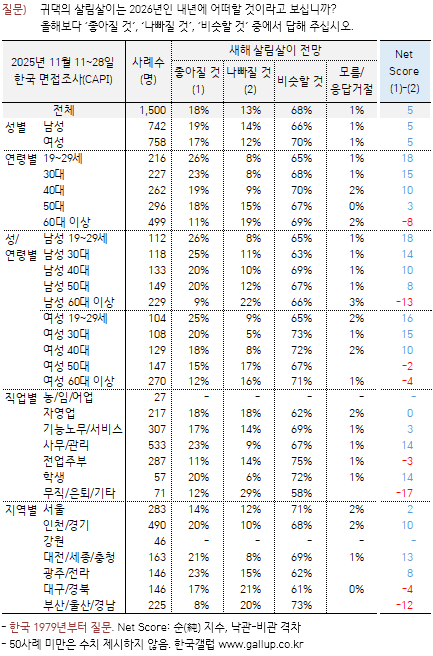
한국인의 새해 살림살이 전망:
'좋아질 것' 18%, '나빠질 것' 13%, '비슷할 것' 68%
- 살림살이 비관론 전년 대비 7%포인트 감소
살림살이 전망에 대해서는 한국인의 18%가 '좋아질 것', 13%는 '나빠질 것', 68%는 '비슷할 것'이라고 답했다. 살림살이 낙관론은 전년 대비 1%포인트 증가, 비관론은 7%포인트 감소했다.
◎ 과거 한국인의 살림살이 전망 추이를 보면, 1980년대 낙관론이 50%를 넘었고 1990년대 들어서는 소폭 하락했으나 그래도 비관론보다는 낙관론이 많았다. 그러나 1997년 IMF를 기점으로 비관론이 40%를 웃돈 이후로는 낙관론이 비관론을 크게 앞선 해가 없다. 2010년대 들어서는 새해 살림살이가 '비슷할 것'이라는 응답이 대체로 50%를 웃돌며, 이번 조사에서는 68%로 최대치다.
◎ 2010년 이후 낙관-비관 격차가 줄고 한국인 과반이 '새해 살림살이도 올해와 비슷할 것'이라고 전망하는 현상은 '지금보다 더 나빠지지 않으면 다행'이라는 인식, 즉 고령화와 저성장 기조 고착에 따른 변화를 불가피한 현실로 받아들였다고 볼 수 있다. 지난 47년간 조사 중 새해 살림살이 낙관론 최고치는 1983년의 66%, 최저치는 2016년·2018년·2020년의 11%다.
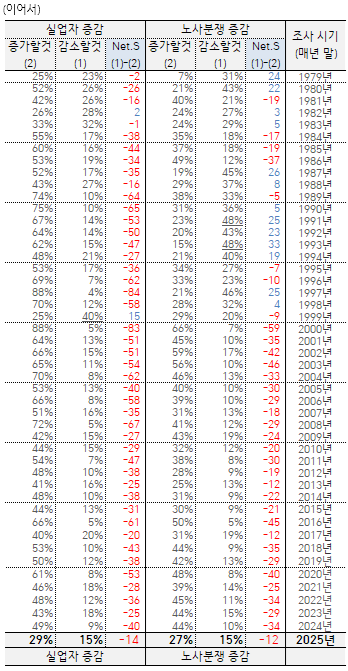
─
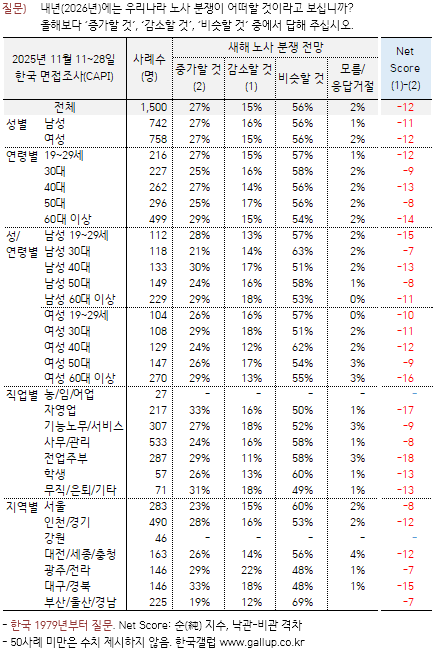
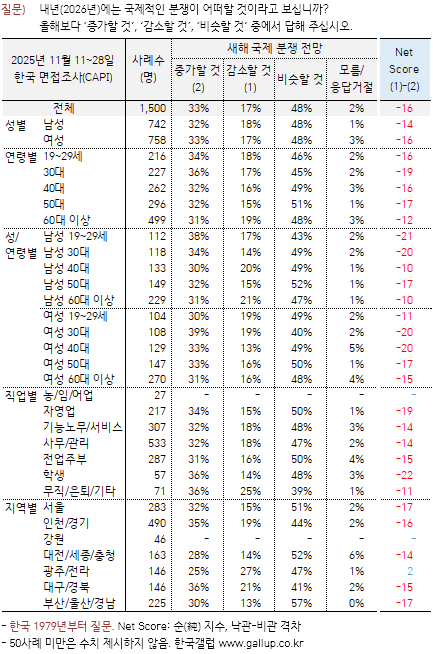
한국인의 국제관계 전망:
냉전 종식 1990년 전후 긍정적, 세계화·초연결 2000년대 들어 비관적
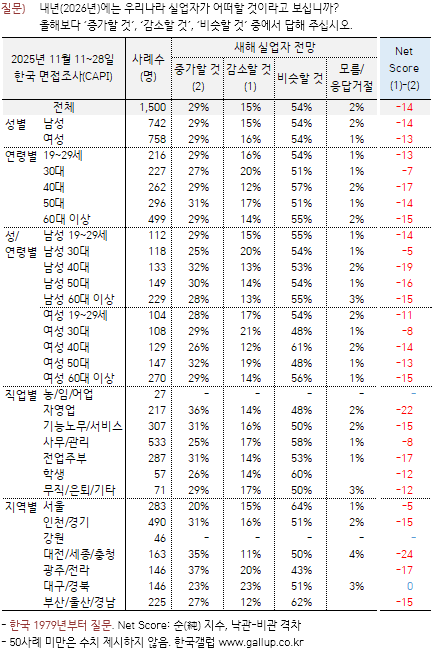
- 실업·노사관계·국제관계 전망, 전년보다 덜 부정적
────────────
한국인의 주관적 행복감
────────────
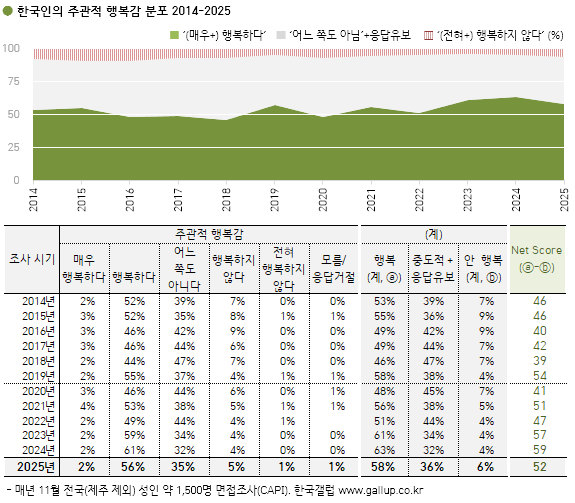
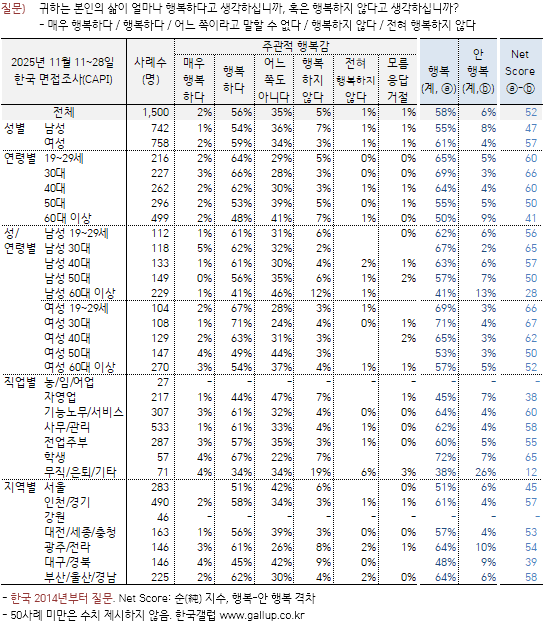
'나의 삶은 행복하다' 58%, '행복하지 않다' 6%, '어느 쪽도 아니다' 35%
- 주관적 행복감 순지수: 20~40대 여성·30대 남성 높은 편, 60대 남성 가장 낮아
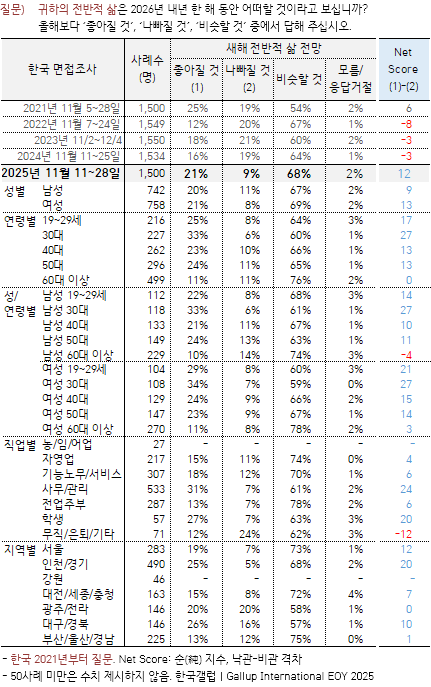
본인 삶이 얼마나 행복하다고 생각하는지, 혹은 행복하지 않다고 생각하는지 물었다(5점 척도). 그 결과 한국인 중 58%가 삶이 '행복하다', 6%가 '행복하지 않다', 35%가 '어느 쪽도 아니다'라고 답했다. 2014년 이후 한국인의 주관적 행복감 순지수('행복'-'안 행복' 응답 차이)는 2018년 39가 최저, 2024년 59가 최고다.
◎ 주관적 행복감 순지수는 여성(57)이 남성(47)보다 높은 편이며, 과거 조사에서도 일관된 경향이었다. 성·연령별 행복감 순지수는 30대 남성과 20~40대 여성(60 이상)이 높은 편이고, 60대 이상 남성(28)이 가장 낮다.
──────────────────
A Divided World Looks to 2026:
Optimism in the Global South, Anxiety in the West and Among Older Generations
──────────────────
The Latest Findings from the World’s Longest-Running Global Public Opinion Study
The Gallup International End-of-Year (EOY) Survey, the world’s longest-running global public opinion study, reveals a sharply divided global outlook as people look ahead to 2026. Conducted annually since 1977, the End-of-Year survey is carried out by the Gallup Interna-tional Association (GIA) — a worldwide network of more than 65 professional and inde-pendent polling organizations operating across continents.
The Association was founded in 1947 by George Gallup, the pioneer of modern scientific public opinion polling, and continues to bring together some of the most experienced and respected survey organizations from around the world to provide a unique, real-time snap-shot of global public sentiment.
The latest End-of-Year survey covers 60 countries and is based on interviews with 59,636 adults, making it one of the most comprehensive internationally coordinated assessments of public sentiment anywhere in the world. A defining feature of the study is that it is conducted within one of the shortest synchronized global fieldwork windows, ensuring that public opinion is captured at the same moment across diverse political, economic, and cultural con-texts.
As the findings show, the world entering 2026 is deeply divided: emerging and developing regions in the Global South remain relatively optimistic, while advanced Western econo-mies — and older generations across regions — express growing anxiety, particularly about economic prospects and global peace.
Hope Remains Present, but Uneven Across Regions
Globally, 37% of respondents believe that 2026 will be a better year than 2025, while 25% expect it to be worse and 31% expect no major change. This produces a Net Hope score of +11, indicating that optimism continues to outweigh pessimism at the global level.
Compared with the End-of-Year 2024 Survey, when 41% expected the coming year to be bet-ter and 24% expected it to be worse, we are marginally less optimistic for 2026.
Hope is strongest in the Global South, particularly in the Arab World, South Asia, Africa , and Latin America, while optimism remains muted across Western and Eastern Europe, where expectations of stagnation are more common.
Across the 60 countries surveyed, a clear majority (40 countries )remain net positive on hope (more people are hopeful about the next year than those who are despaired), though levels of optimism vary widely by region.
Hope Remains Present, but Uneven Across Regions
Public sentiment turns sharply more negative when respondents are asked about the econo-my. Only one in four (24%) expect economic prosperity in 2026, while 40% expect econom-ic difficulty. Another 30% expect conditions to remain the same, producing a Net Prosperity score of –16.
This represents a clear deterioration from End-of-Year 2024, when 29% expected prosperity and 35% expected difficulty. Economic pessimism is particularly pronounced in advanced economies, especially in Western and Eastern Europe.
By contrast, net positive economic expectations are concentrated in the Arab World, South Asia, Africa, and parts of Latin America, reflecting differing economic trajectories and ex-pectations.
Globally, more countries are net negative (44 countries) than net positive on economic expectations.
Global Peace: Widespread Concern About a Troubled World
Concerns extend beyond economics to global stability.
Globally, 40% of respondents expect the world to become more troubled in 2026, while 26% believe it will become more peaceful. Another 28% expect no major change, resulting in a Net Peace score of –14, the most pessimistic of the three indicators.
Expectations of a more troubled world are strongest in Western Europe, North America, and Australasia, while relatively more optimistic views are found in the Arab World, South Asia, and parts of Africa, where hopes for stabilization persist.
Across countries, a clear majority are net negative on global peace (42 countries), highlight-ing deep concern about geopolitical instability.
Countries Cluster into Distinct Global “Mood Groups”
Looking across hope, economic expectations, and views on global peace, countries cluster into distinct global “mood groups.”
Only a small group of countries show consistent optimism across all three dimensions, including Saudi Arabia, Kenya, South Africa, Colombia, Pakistan, and Moldova — coun-tries largely located in the Global South.
A much larger group is hopeful about the future but anxious about the economy and/or global stability, including India, Argentina, Mexico, Peru, Malaysia, the Philippines, Japan, South Korea, and the United States.
At the other end of the spectrum, a broad group of countries — predominantly in Western and Eastern Europe — are pessimistic across all three indicators, including Germany, France, Belgium, the Netherlands, Austria, Greece, Poland, Romania, and Bulgaria.
Finally, a small number of societies — notably Japan, South Korea, and Norway — stand out for expecting little change rather than clear improvement or decline, reflecting stability but limited optimism.
Demographic Snapshot: Who Is Optimistic — and Who Is Not
• Age is the strongest divide: under-34s remain broadly optimistic (Net Hope +28), while those aged 55+ are net pessimistic on hope (–6), the economy (–29), and global peace (–30).
• Gender differences are minimal, with men and women showing similar views across hope, economic outlook, and peace.
• Overall, optimism is concentrated among the young and the Global South, while older populations in wealthier countries are the most anxious about the future.
Conclusion
Michael Nitsche, President of Gallup International Association, summarizes the results: “In view of the gloomy economic outlook and widespread concerns about peaceful coexistence in large parts of the world, there will be a greater need for engaged leaders from the areas of business, culture, and politics who can show people a constructive way forward and turn global public sentiment in a positive direction.”
───
한국 응답자 특성표
| ● 1947년 조지 갤럽 박사가 설립한 갤럽 인터내셔널(Gallup International Association)은 1977년부터 전 세계 회원사들이 매년 말 자국민을 대상으로 경제, 노동, 국제 관계 등 현안에 대한 인식과 새해 전망을 알아보는 〈End of Year Survey〉를 해왔습니다. → Press release for the 120th Anniversary of Dr. George Gallup ● 한국갤럽은 1979년부터 47년간 이 조사에 참여하며, 매년 한국인의 새해 전망을 연하장에 담아왔습니다. 아래 이미지를 클릭하시면 전면을 보실 수 있습니다(실물 크기: 가로 80cm, 세로 15cm). |
→ 최근 6년 연하장: 2026년 | 2025년 | 2024년 | 2023년 | 2022년 | 2021년
2026년 새해 전망: Gallup International 다국가 조사
→ 한국 조사 결과 파일 다운로드(PDF)
→ 60개국 조사 결과 전체 보기 & 파일
/ 세계 조사 개요
- 2025년 10~12월 60개국 성인 총 59,636명 전화/온라인/면접조사(주제별 참여국 상이)
/ 한국 조사 개요
· 조사기간: 2025년 11월 11~28일
· 표본추출: 층화 집락 확률 비례 추출
· 응답방식: 면접조사원 인터뷰(CAPI)
· 조사대상: 전국(제주 제외) 만 19세 이상 1,500명
· 표본오차: ±2.5%포인트(95% 신뢰수준)
· 응답률: 34.5%(총 접촉 4,348명 중 1,500명 응답 완료)
· 의뢰처: 한국갤럽-Gallup International 자체 조사
/ 조사 항목(화살표(→) 옆 단어 클릭하면 해당 위치로 이동)
→ 60개국 2026년 새해 전망 | 자국 경제(경기) 전망 | 세계 정세 전망
→ 한국인의 새해 전망 47년간 추이: 경기/살림살이/실업자/노사관계/국제관계
→ 한국인의 주관적 행복감
→ (영문) Gallup International commentary
→ 한국 응답자 특성표
요약
[60개국 2026년 새해 전망] 낙관 37%, 비관 25%, 불변 31%
[새해 자국 경제] '좋아질 것' 24%, '나빠질 것' 40%, '비슷할 것' 31%
· 한국: 전반적 삶, 세계 정세 낙관론 60개국 평균 크게 밑돌아
[새해 세계 정세] '평화로울 것' 26%, '혼란스러울 것' 40%, 불변 28%
[한국] 경기, 살림살이, 실업, 노사, 국제관계 전반에 걸쳐 전년 대비 비관론 완화
· 주관적 행복감 순지수: 20~40대 여성·30대 남성 높은 편, 60대 남성 가장 낮아
조사 결과
────────────
60개국 2026년 새해 전망
────────────
'좋아질 것' 37%, '나빠질 것' 25%, '비슷할 것' 31%
2025년 10~12월 갤럽 인터내셔널이 세계 60개국 성인 59,636명에게 2026년 새해 전망을 물은 결과 '좋아질 것' 37%, '나빠질 것' 25%, '비슷할 것' 31%로 낙관론이 비관론을 앞섰다. 1년 전과 비교하면 낙관론이 4%포인트 줄고, 비관론은 1%포인트 늘었다.
◎ 새해 전망을 가장 밝게 보는 나라는 케냐로, 78%가 '2026년이 2025년보다 좋아질 것'이라고 답했다. 그다음은 시리아(73%), 남아프리카공화국(68%), 사우디아라비아(66%), 인도(59%), 콜롬비아(56%), 아르메니아(54%) 순이다. 한편, 우리 주변국 중에서는 미국(39%)과 러시아(37%)가 60개국 평균 수준, 일본(24%)은 우리나라(21%)와 함께 하위권에 속했다.
────────────
60개국 새해 자국 경제 전망
────────────
'좋아질 것' 24%, '나빠질 것' 40%, '비슷할 것' 31%
2026년 새해 자국 경제(경기) 전망에 관해서는 '좋아질 것' 24%, '나빠질 것' 40%, '비슷할 것' 31%로 비관론이 낙관론을 앞섰고, 격차도 전년보다 커졌다. 1년 전과 비교하면 경기 낙관론이 5%포인트 줄고, 그만큼 비관론이 늘었다.
◎ 새해 자국 경기를 가장 낙관적으로 보는 나라는 케냐와 사우디아라비아로, 각각 66%가 '좋아질 것'이라고 답했다. 그다음은 시리아(57%), 파키스탄·콜롬비아(53%), 남아프리카공화국(51%) 순이다. 이외 주요국 낙관론은 세계 평균과 비슷하거나 그보다 뒤졌다: 미국 30%, 러시아 24%, 한국·일본 19%, 독일 5%.
◎ 이번 조사에 참여한 60개 나라 중 자국 경기 낙관론이 비관론보다 10%포인트 이상 많은 나라는 12개국, 반대로 비관론이 낙관론보다 10%포인트 이상 많은 나라는 37개국이다.
────────────
60개국 새해 세계 정세 전망
────────────
'세계가 더 평화로울 것' 26%, '더 혼란스러울 것' 40%, '비슷할 것' 28%
2026년 새해 세계 정세에 관해서는 26%가 '더 평화로울 것', 40%가 '더 혼란스러울 것', '비슷할 것' 28%로 비관론이 낙관론을 앞섰다. 가장 낙관적인 나라는 시리아와 케냐로, 새해 세계가 '더 평화로울 것'이란 응답이 각각 66%를 차지했다. 사우디아라비아(58%), 페루·남아프리카공화국(57%), 파키스탄·아르메니아(52%), 에콰도르·카자흐스탄(51%) 등에서도 낙관론이 50%를 넘었다.
◎ 세계 정세 비관론이 많은 나라는 네덜란드(68%), 벨기에(67%), 독일(65%), 가나·프랑스(62%) 등 유럽 국가가 다수를 차지한다. 그러나 2022년 2월부터 지속 중인 러시아-우크라이나 전쟁 당사국 두 나라는 주변 유럽 국가들보다 오히려 덜 비관적이다(지난 2023년 조사에서도 그랬다).
────────────
한국인의 새해 전망: 경기/살림살이/실업자/노사관계/국제관계
────────────
─
한국인의 2026년 새해 국가 경제 전망:
'좋아질 것' 19%, '나빠질 것' 24%, '비슷할 것' 55%
- 경기 낙관론 전년 대비 10%포인트 증가, 비관론 23%포인트 감소
한국갤럽이 2025년 11월 11~28일 전국(제주 제외)의 만 19세 이상 1,500명에게 새해 우리나라 경제가 어떠할 것이라고 보는지 물었다. 그 결과, 한국 성인 중 19%가 '좋아질 것', 24%는 '나빠질 것', 55%는 '비슷할 것'이라고 답했다. 새해 경기 낙관론은 전년 대비 10%포인트 증가, 비관론은 23%포인트 감소했다.
◎ 2022년 초 러시아·우크라이나 전쟁에서 비롯한 에너지난과 각국의 급격한 재정 긴축 기조, 국내 부동산 거래 급감과 시세 하락 등은 향후 장기적 경기 침체의 전조로 해석된 바 있다. 고금리·고물가 현상은 지금까지도 이어지고 있으나, 2024년 11월 비상계엄 사태 직전 실각 위기의 윤석열 정부 당시와 비교하면 2025년 11월은 새 정부 출범 초반 기대감과 국내 증시 부양에 힘입어 비관론이 걷힌 듯하다. 한국갤럽의 매월 경기 전망 순지수 흐름도 2025년 6월 이후 크게 달라졌다(→ 제649호).
◎ 과거 한국인의 경기 전망 추이를 보면, 1980년대는 주로 낙관론이 비관론을 크게 앞섰으나 1990년대는 낙관과 비관 우세가 교차 혼재했고 2000년대 들어서는 대체로 비관론이 우세했다. 1979년부터 2022년까지 47년간 조사 중 '새해 경기가 좋아질 것'이란 낙관론 최고치는 1983년의 69%, 최저치는 국정농단 파문이 거셌던 2016년의 4%다.
─
한국인의 새해 살림살이 전망:
'좋아질 것' 18%, '나빠질 것' 13%, '비슷할 것' 68%
- 살림살이 비관론 전년 대비 7%포인트 감소
살림살이 전망에 대해서는 한국인의 18%가 '좋아질 것', 13%는 '나빠질 것', 68%는 '비슷할 것'이라고 답했다. 살림살이 낙관론은 전년 대비 1%포인트 증가, 비관론은 7%포인트 감소했다.
◎ 과거 한국인의 살림살이 전망 추이를 보면, 1980년대 낙관론이 50%를 넘었고 1990년대 들어서는 소폭 하락했으나 그래도 비관론보다는 낙관론이 많았다. 그러나 1997년 IMF를 기점으로 비관론이 40%를 웃돈 이후로는 낙관론이 비관론을 크게 앞선 해가 없다. 2010년대 들어서는 새해 살림살이가 '비슷할 것'이라는 응답이 대체로 50%를 웃돌며, 이번 조사에서는 68%로 최대치다.
◎ 2010년 이후 낙관-비관 격차가 줄고 한국인 과반이 '새해 살림살이도 올해와 비슷할 것'이라고 전망하는 현상은 '지금보다 더 나빠지지 않으면 다행'이라는 인식, 즉 고령화와 저성장 기조 고착에 따른 변화를 불가피한 현실로 받아들였다고 볼 수 있다. 지난 47년간 조사 중 새해 살림살이 낙관론 최고치는 1983년의 66%, 최저치는 2016년·2018년·2020년의 11%다.
─
한국인의 국제관계 전망:
냉전 종식 1990년 전후 긍정적, 세계화·초연결 2000년대 들어 비관적
- 실업·노사관계·국제관계 전망, 전년보다 덜 부정적
────────────
한국인의 주관적 행복감
────────────
'나의 삶은 행복하다' 58%, '행복하지 않다' 6%, '어느 쪽도 아니다' 35%
- 주관적 행복감 순지수: 20~40대 여성·30대 남성 높은 편, 60대 남성 가장 낮아
본인 삶이 얼마나 행복하다고 생각하는지, 혹은 행복하지 않다고 생각하는지 물었다(5점 척도). 그 결과 한국인 중 58%가 삶이 '행복하다', 6%가 '행복하지 않다', 35%가 '어느 쪽도 아니다'라고 답했다. 2014년 이후 한국인의 주관적 행복감 순지수('행복'-'안 행복' 응답 차이)는 2018년 39가 최저, 2024년 59가 최고다.
◎ 주관적 행복감 순지수는 여성(57)이 남성(47)보다 높은 편이며, 과거 조사에서도 일관된 경향이었다. 성·연령별 행복감 순지수는 30대 남성과 20~40대 여성(60 이상)이 높은 편이고, 60대 이상 남성(28)이 가장 낮다.
──────────────────
A Divided World Looks to 2026:
Optimism in the Global South, Anxiety in the West and Among Older Generations
──────────────────
The Latest Findings from the World’s Longest-Running Global Public Opinion Study
The Gallup International End-of-Year (EOY) Survey, the world’s longest-running global public opinion study, reveals a sharply divided global outlook as people look ahead to 2026. Conducted annually since 1977, the End-of-Year survey is carried out by the Gallup Interna-tional Association (GIA) — a worldwide network of more than 65 professional and inde-pendent polling organizations operating across continents.
The Association was founded in 1947 by George Gallup, the pioneer of modern scientific public opinion polling, and continues to bring together some of the most experienced and respected survey organizations from around the world to provide a unique, real-time snap-shot of global public sentiment.
The latest End-of-Year survey covers 60 countries and is based on interviews with 59,636 adults, making it one of the most comprehensive internationally coordinated assessments of public sentiment anywhere in the world. A defining feature of the study is that it is conducted within one of the shortest synchronized global fieldwork windows, ensuring that public opinion is captured at the same moment across diverse political, economic, and cultural con-texts.
As the findings show, the world entering 2026 is deeply divided: emerging and developing regions in the Global South remain relatively optimistic, while advanced Western econo-mies — and older generations across regions — express growing anxiety, particularly about economic prospects and global peace.
Hope Remains Present, but Uneven Across Regions
Globally, 37% of respondents believe that 2026 will be a better year than 2025, while 25% expect it to be worse and 31% expect no major change. This produces a Net Hope score of +11, indicating that optimism continues to outweigh pessimism at the global level.
Compared with the End-of-Year 2024 Survey, when 41% expected the coming year to be bet-ter and 24% expected it to be worse, we are marginally less optimistic for 2026.
Hope is strongest in the Global South, particularly in the Arab World, South Asia, Africa , and Latin America, while optimism remains muted across Western and Eastern Europe, where expectations of stagnation are more common.
| Top 5 Most Hopeful Countries (Net Hope) Kenya (+67), Syria (+61), Saudi Arabia (+58), South Africa (+52), Colombia (+45) Bottom 5 Least Hopeful Countries Bulgaria (–36), Bosnia & Herzegovina (–28), Austria (–26), Belgium (–26), Ghana (–26) |
Across the 60 countries surveyed, a clear majority (40 countries )remain net positive on hope (more people are hopeful about the next year than those who are despaired), though levels of optimism vary widely by region.
Hope Remains Present, but Uneven Across Regions
Public sentiment turns sharply more negative when respondents are asked about the econo-my. Only one in four (24%) expect economic prosperity in 2026, while 40% expect econom-ic difficulty. Another 30% expect conditions to remain the same, producing a Net Prosperity score of –16.
This represents a clear deterioration from End-of-Year 2024, when 29% expected prosperity and 35% expected difficulty. Economic pessimism is particularly pronounced in advanced economies, especially in Western and Eastern Europe.
By contrast, net positive economic expectations are concentrated in the Arab World, South Asia, Africa, and parts of Latin America, reflecting differing economic trajectories and ex-pectations.
| Top 5 Most Economically Optimistic Countries (Net Prosperity) Saudi Arabia (+54), Kenya (+47), Syria (+35), Colombia (+34), Pakistan (+26) Bottom 5 Most Economically Pessimistic Countries Belgium (–59), France (–54), Latvia (–54), Ukraine (–54), Germany (–53) |
Globally, more countries are net negative (44 countries) than net positive on economic expectations.
Global Peace: Widespread Concern About a Troubled World
Concerns extend beyond economics to global stability.
Globally, 40% of respondents expect the world to become more troubled in 2026, while 26% believe it will become more peaceful. Another 28% expect no major change, resulting in a Net Peace score of –14, the most pessimistic of the three indicators.
Expectations of a more troubled world are strongest in Western Europe, North America, and Australasia, while relatively more optimistic views are found in the Arab World, South Asia, and parts of Africa, where hopes for stabilization persist.
| Top 5 Most Optimistic About Global Peace (Net Peace) Syria (+50), Kenya (+48), Saudi Arabia (+43), Peru (+41), Armenia (+33) Bottom 5 Most Pessimistic About Global Peace Netherlands (–61), Germany (–59), Belgium (–57), Greece (–54), Ghana (–52) |
Across countries, a clear majority are net negative on global peace (42 countries), highlight-ing deep concern about geopolitical instability.
Countries Cluster into Distinct Global “Mood Groups”
Looking across hope, economic expectations, and views on global peace, countries cluster into distinct global “mood groups.”
Only a small group of countries show consistent optimism across all three dimensions, including Saudi Arabia, Kenya, South Africa, Colombia, Pakistan, and Moldova — coun-tries largely located in the Global South.
A much larger group is hopeful about the future but anxious about the economy and/or global stability, including India, Argentina, Mexico, Peru, Malaysia, the Philippines, Japan, South Korea, and the United States.
At the other end of the spectrum, a broad group of countries — predominantly in Western and Eastern Europe — are pessimistic across all three indicators, including Germany, France, Belgium, the Netherlands, Austria, Greece, Poland, Romania, and Bulgaria.
Finally, a small number of societies — notably Japan, South Korea, and Norway — stand out for expecting little change rather than clear improvement or decline, reflecting stability but limited optimism.
Demographic Snapshot: Who Is Optimistic — and Who Is Not
• Age is the strongest divide: under-34s remain broadly optimistic (Net Hope +28), while those aged 55+ are net pessimistic on hope (–6), the economy (–29), and global peace (–30).
• Gender differences are minimal, with men and women showing similar views across hope, economic outlook, and peace.
• Overall, optimism is concentrated among the young and the Global South, while older populations in wealthier countries are the most anxious about the future.
Conclusion
Michael Nitsche, President of Gallup International Association, summarizes the results: “In view of the gloomy economic outlook and widespread concerns about peaceful coexistence in large parts of the world, there will be a greater need for engaged leaders from the areas of business, culture, and politics who can show people a constructive way forward and turn global public sentiment in a positive direction.”
───
한국 응답자 특성표