- 가계 형편 - WIN 다국가 조사 #개인재정 #물가 #생활비 #지출
- 조사일 : 2022/12/10
- [GallupReport(20230119)_Cost_of_Living_WIN.pdf] 다운로드
● 2023년 1월 19일(목) 공개 | 문의: 02-3702-2571/2621/2622
가계 형편 - WIN 다국가 조사
→ 한국+세계 조사 결과 파일 다운로드(PDF)
/ 세계 조사 개요
- 2022년 10~12월 36개국 성인 총 29,739명 전화/온라인/면접조사(주제별 참여국 상이)
/ 한국 조사 개요
- 조사기간: 2022년 11월 7~24일
- 표본추출: 층화 집락 확률 비례 추출
- 응답방식: 면접조사원 인터뷰(CAPI)
- 조사대상: 전국(제주 제외) 만 19세 이상 1,549명
- 표본오차: ±2.5%포인트(95% 신뢰수준)
- 응답률: 26.7%(총 접촉 5,802명 중 1,549명 응답 완료)
- 의뢰처: 한국갤럽-WIN 자체 조사
/ 조사 항목
- 현재 개인 재정 상황
- 생활비·물가 상승으로 인한 지출 영향
(※ 세계 조사 상세 결과는 첨부 파일 참조)
요약
- 36개국 성인 36% '근근이 산다', '돈 걱정·부족함 없다' 25%
/ 아르헨티나·케냐·레바논, 개인 재정난 극심
- 생활비·물가 상승으로 '이미 지출 줄였다' 48%, '줄일 계획' 29%
- 한국 가계 상황 인식, 다른 나라보다 안정적
/ 지출 절감에는 상대적으로 소극적
/ 다른 조사에서도 경기 전망은 비관적, 가계 전망은 관망적
조사 결과
2022년 10~12월 36개국 성인 36% '근근이 산다', '돈 걱정·부족함 없다' 25%
- 생활비·물가 상승으로 '이미 지출 줄였다' 48%, '줄일 계획' 29%, '영향 없다' 19%
- 아르헨티나·케냐·레바논, 개인 재정난 극심
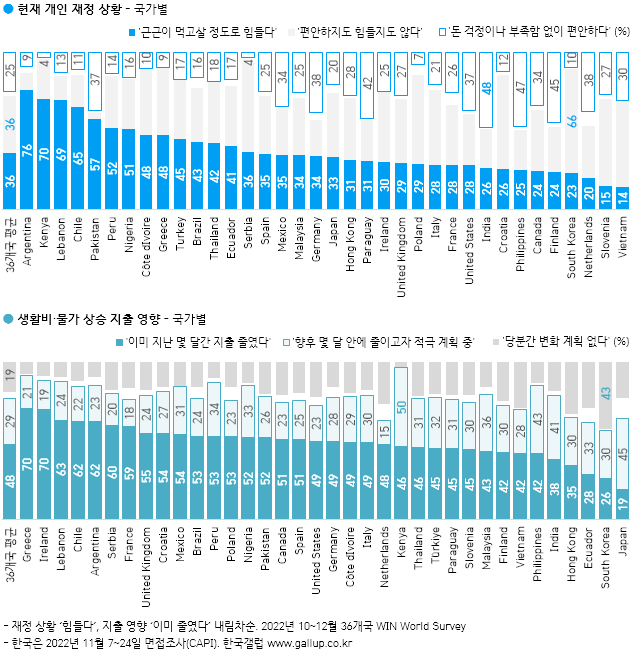
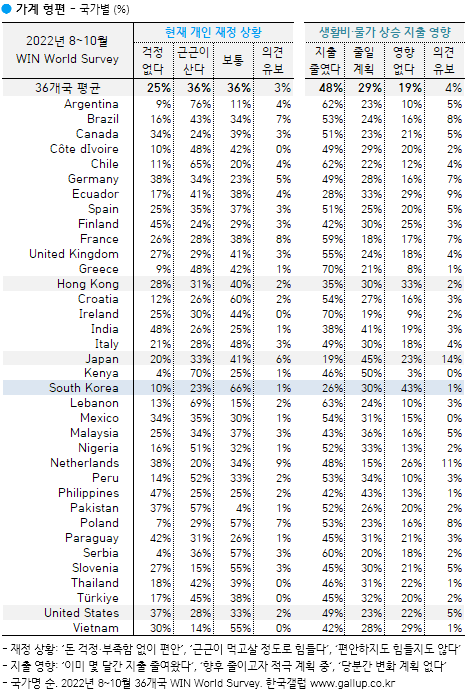
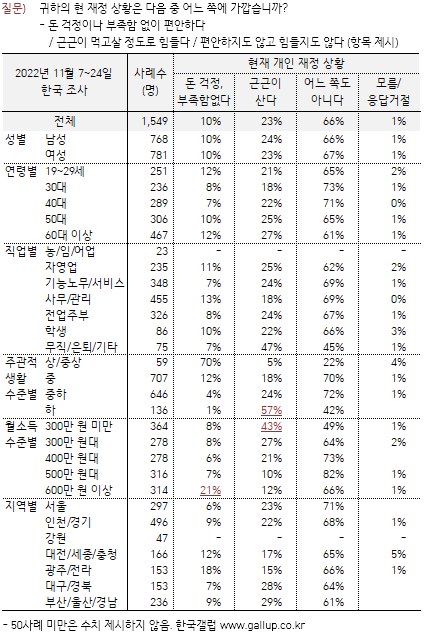
글로벌 조사 네트워크 WIN이 2022년 10~12월 36개국 성인 29,739명에게 현재 개인 재정 상황과 최근 생활비·물가 상승으로 인한 지출 영향에 관해 물었다. 먼저 개인 재정 상황부터 보면 '근근이 먹고살 정도로 힘들다'고 답한 사람이 36%, '돈 걱정이나 부족함 없이' 사는 사람은 25%, 그리고 힘들지도 넉넉하지도 않은 사람이 36%를 차지했다. 36개국 중 개인 재정난 호소자가 가장 많은 나라는 아르헨티나(76%), 케냐(70%), 레바논(69%), 칠레(65%), 파키스탄(57%) 순이며, 저학력일수록 그 비율이 높았다(초등 이하 50% 내외; 석사 이상 25%).
◎ 코로나19 팬데믹 기간 과잉 유동성 여파로 각국은 2022년부터 인플레이션에 직면했고, 가파른 금리 인상 등 고강도 긴축 중이다. 이 여파로 36개국 시민 열에 여덟이 이미 지출을 줄였거나 줄일 계획이라고 밝혔지만, 나머지는 아직 그럴 생각이 없는 것으로 파악됐다. 지출과 관련해서는 최근 생활비·물가 상승 때문에 '이미 지난 몇 달간 지출을 줄여왔다' 48%, '향후 몇 달 안에 줄이고자 적극 계획 중이다' 29%, '지금도 앞으로도 당분간 변화 계획 없다' 19%로 나타났다. 36개국 중 이미 지출을 줄인 사람이 가장 많은 나라는 그리스와 아일랜드(70%), 가장 적은 나라는 일본(19%)이다.
─
한국 가계 상황 인식, 다른 나라보다 안정적
- 지출 절감에는 상대적으로 소극적
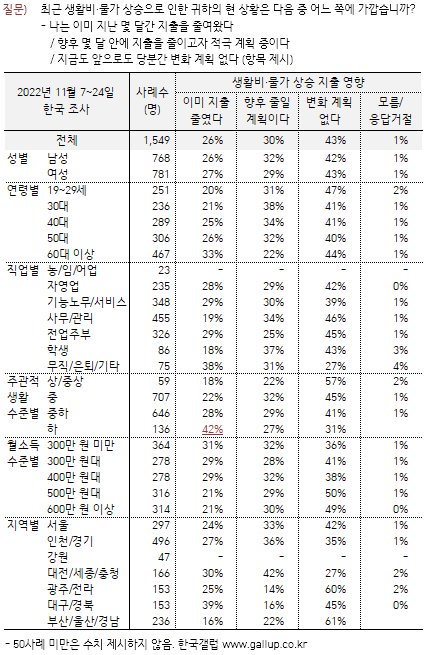
한국 조사는 2022년 11월 7~24일 전국(제주 제외) 만 19세 이상 1,549명을 대상으로 했다. 개인 재정 상황 질문에는 '돈 걱정·부족함 없다' 10%, '근근이 산다' 23%였고, 힘들지도 넉넉하지도 않다는 사람이 66%로 가장 많았다. 한편, 26%는 최근 생활비·물가 상승으로 이미 지출을 줄였고 30%도 곧 줄일 계획이며, 43%는 변화 계획 없다고 답했다.
◎ 한국인 중 돈 걱정 없는 사람은 케냐·세르비아(4%), 폴란드(7%), 아르헨티나·그리스(9%), 칠레(11%), 크로아티아(12%) 등과 함께 36개국 중 최저 수준, 근근이 산다는 사람도 캐나다·핀란드(24%), 네덜란드(20%), 슬로베니아(15%), 베트남(14%) 등과 함께 최저 수준이다. 반면 힘들지도 넉넉하지도 않다고 보는 관망자는 거의 열에 일곱으로 36개국 중 가장 많다. 한국의 지출 절감(+계획)자 비율은 56%로 36개국 중 가장 적다.
◎ 이상을 요약하면 현재 한국의 가계 상황 인식은 이번 조사에 참여한 다른 나라들보다 그리 심각한 수준이 아니고, 고물가·고금리에도 지출 절감에 상대적으로 소극적이다. 단기적으로 보면 코로나19 팬데믹을 벗어나는 충격파가 덜하다고 볼 수 있고, 장기적으로 보면 2000년 이후 고령화·저성장 기조 고착화에 익숙해진 것으로도 읽힌다. 2023년 새해 경기(국가 경제) 전망에서도 비관론(49%)이 낙관론(9%)을 크게 앞섰으나, 전반적인 삶과 살림살이에 관해서는 지금보다 더 좋아지지도 나빠지지도 않을 것이라고 관망하는 태도가 지배적이었다(→ G20221229).
──────────────────
People worldwide struggle due to
increase in the cost of living
──────────────────
WIN International, the world's leading association in market research and polling, has published the Annual WIN World Survey - WWS 2022 - exploring the views and beliefs of 29,739 individuals among citizens from 36 countries across the globe.
The survey analyzes views and opinions related to the current financial situation of citizens and how they are dealing with inflation and the increase in the cost of leaving.
HEADLINES
The war between Russia and Ukraine and the pandemic affected all economies worldwide and the cost of living became a crucial factor.
Financial situation
The cost of living has increased due to various factors, including COVID-19 and political and economic crises affecting many countries. Many people are so financially struggled that only 25% of citizens worldwide are living comfortably. People between the ages of 35 and 44 are among the most affected ones, probably because of the costs related to supporting a family. Interestingly, there are also significant differences according to the educational level of respondents: more than half of the interviewed people (54%) who have basic education or no education have difficulties in paying their bills, while interviewees who have completed higher educational levels (Masters, PHD, etc.) have less difficulties in this regard (25% say they struggle financially). On a country level, Argentina (76%), Lebanon (69%) and Chile (65%) are among the countries with the highest percentage of population expressing financial difficulties.
The rising of cost of living
People around the world have been forced to reduce expenses due to the rising cost of living. In fact, 48% of those surveyed have already reduced some expenses in previous months, with the 45-54 age group being the most affected ones (51%). On the other hand, 19% of the respondents do not plan to make any changes in their monthly budget, a percentage slightly higher among people over 65 years (24%).
Analyzing results by employment status, there is no evidence of significant differences: both full-time employees and unemployed have already made a reduction on their expenses or plan to do so (77% and 79%, respectively). However, significant differences are registered within countries: for example, people in Greece and Ireland have already cut their spending (both 70%), while only 19% of citizens in Japan have done so.
Vilma Scarpino,
President of WIN International Association, said:
“This year, for the first time, the WIN World Survey focuses on the financial situation of citizens. The historical time we’re living, affected by the pandemic, the rising of conflicts in many areas of the world, the climate emergency, and insecurities towards the future, forces us to take increasingly more into consideration people’s social and financial wellbeing as well. Research on many different sectors and aspects of life cannot overlook people’s spending possibilities. And it’s not only about finance: the rising costs of living affect people social wellbeing too.
Interestingly, this study highlights more differences between countries than many others do. While there are some common widely accepted stands (e.g., agreement on climate change is high in every country) the financial situation differ significantly between different parts of the world. WWS data might serve therefore, together with other sources, as a starting point for institutions, governments and NGOs to work on improving financial stability.”
───
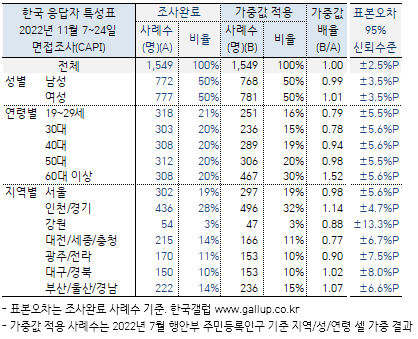
한국 응답자 특성표
| 전 대륙에서 시장조사와 여론조사를 하는 글로벌 네트워크 WIN(Worldwide Independent Network of Market Research)은 매년 말 건강, 환경, IT 등 여러 분야 현안에 관해 다국가 조사를 하고 있습니다. 오늘은 2022년 10~12월 36개국 성인을 대상으로 조사한 〈가계 형편〉 관련 인식을 전합니다. |
가계 형편 - WIN 다국가 조사
→ 한국+세계 조사 결과 파일 다운로드(PDF)
/ 세계 조사 개요
- 2022년 10~12월 36개국 성인 총 29,739명 전화/온라인/면접조사(주제별 참여국 상이)
/ 한국 조사 개요
- 조사기간: 2022년 11월 7~24일
- 표본추출: 층화 집락 확률 비례 추출
- 응답방식: 면접조사원 인터뷰(CAPI)
- 조사대상: 전국(제주 제외) 만 19세 이상 1,549명
- 표본오차: ±2.5%포인트(95% 신뢰수준)
- 응답률: 26.7%(총 접촉 5,802명 중 1,549명 응답 완료)
- 의뢰처: 한국갤럽-WIN 자체 조사
/ 조사 항목
- 현재 개인 재정 상황
- 생활비·물가 상승으로 인한 지출 영향
(※ 세계 조사 상세 결과는 첨부 파일 참조)
요약
- 36개국 성인 36% '근근이 산다', '돈 걱정·부족함 없다' 25%
/ 아르헨티나·케냐·레바논, 개인 재정난 극심
- 생활비·물가 상승으로 '이미 지출 줄였다' 48%, '줄일 계획' 29%
- 한국 가계 상황 인식, 다른 나라보다 안정적
/ 지출 절감에는 상대적으로 소극적
/ 다른 조사에서도 경기 전망은 비관적, 가계 전망은 관망적
조사 결과
2022년 10~12월 36개국 성인 36% '근근이 산다', '돈 걱정·부족함 없다' 25%
- 생활비·물가 상승으로 '이미 지출 줄였다' 48%, '줄일 계획' 29%, '영향 없다' 19%
- 아르헨티나·케냐·레바논, 개인 재정난 극심
글로벌 조사 네트워크 WIN이 2022년 10~12월 36개국 성인 29,739명에게 현재 개인 재정 상황과 최근 생활비·물가 상승으로 인한 지출 영향에 관해 물었다. 먼저 개인 재정 상황부터 보면 '근근이 먹고살 정도로 힘들다'고 답한 사람이 36%, '돈 걱정이나 부족함 없이' 사는 사람은 25%, 그리고 힘들지도 넉넉하지도 않은 사람이 36%를 차지했다. 36개국 중 개인 재정난 호소자가 가장 많은 나라는 아르헨티나(76%), 케냐(70%), 레바논(69%), 칠레(65%), 파키스탄(57%) 순이며, 저학력일수록 그 비율이 높았다(초등 이하 50% 내외; 석사 이상 25%).
◎ 코로나19 팬데믹 기간 과잉 유동성 여파로 각국은 2022년부터 인플레이션에 직면했고, 가파른 금리 인상 등 고강도 긴축 중이다. 이 여파로 36개국 시민 열에 여덟이 이미 지출을 줄였거나 줄일 계획이라고 밝혔지만, 나머지는 아직 그럴 생각이 없는 것으로 파악됐다. 지출과 관련해서는 최근 생활비·물가 상승 때문에 '이미 지난 몇 달간 지출을 줄여왔다' 48%, '향후 몇 달 안에 줄이고자 적극 계획 중이다' 29%, '지금도 앞으로도 당분간 변화 계획 없다' 19%로 나타났다. 36개국 중 이미 지출을 줄인 사람이 가장 많은 나라는 그리스와 아일랜드(70%), 가장 적은 나라는 일본(19%)이다.
─
한국 가계 상황 인식, 다른 나라보다 안정적
- 지출 절감에는 상대적으로 소극적
한국 조사는 2022년 11월 7~24일 전국(제주 제외) 만 19세 이상 1,549명을 대상으로 했다. 개인 재정 상황 질문에는 '돈 걱정·부족함 없다' 10%, '근근이 산다' 23%였고, 힘들지도 넉넉하지도 않다는 사람이 66%로 가장 많았다. 한편, 26%는 최근 생활비·물가 상승으로 이미 지출을 줄였고 30%도 곧 줄일 계획이며, 43%는 변화 계획 없다고 답했다.
◎ 한국인 중 돈 걱정 없는 사람은 케냐·세르비아(4%), 폴란드(7%), 아르헨티나·그리스(9%), 칠레(11%), 크로아티아(12%) 등과 함께 36개국 중 최저 수준, 근근이 산다는 사람도 캐나다·핀란드(24%), 네덜란드(20%), 슬로베니아(15%), 베트남(14%) 등과 함께 최저 수준이다. 반면 힘들지도 넉넉하지도 않다고 보는 관망자는 거의 열에 일곱으로 36개국 중 가장 많다. 한국의 지출 절감(+계획)자 비율은 56%로 36개국 중 가장 적다.
◎ 이상을 요약하면 현재 한국의 가계 상황 인식은 이번 조사에 참여한 다른 나라들보다 그리 심각한 수준이 아니고, 고물가·고금리에도 지출 절감에 상대적으로 소극적이다. 단기적으로 보면 코로나19 팬데믹을 벗어나는 충격파가 덜하다고 볼 수 있고, 장기적으로 보면 2000년 이후 고령화·저성장 기조 고착화에 익숙해진 것으로도 읽힌다. 2023년 새해 경기(국가 경제) 전망에서도 비관론(49%)이 낙관론(9%)을 크게 앞섰으나, 전반적인 삶과 살림살이에 관해서는 지금보다 더 좋아지지도 나빠지지도 않을 것이라고 관망하는 태도가 지배적이었다(→ G20221229).
──────────────────
People worldwide struggle due to
increase in the cost of living
──────────────────
WIN International, the world's leading association in market research and polling, has published the Annual WIN World Survey - WWS 2022 - exploring the views and beliefs of 29,739 individuals among citizens from 36 countries across the globe.
The survey analyzes views and opinions related to the current financial situation of citizens and how they are dealing with inflation and the increase in the cost of leaving.
HEADLINES
The war between Russia and Ukraine and the pandemic affected all economies worldwide and the cost of living became a crucial factor.
Financial situation
The cost of living has increased due to various factors, including COVID-19 and political and economic crises affecting many countries. Many people are so financially struggled that only 25% of citizens worldwide are living comfortably. People between the ages of 35 and 44 are among the most affected ones, probably because of the costs related to supporting a family. Interestingly, there are also significant differences according to the educational level of respondents: more than half of the interviewed people (54%) who have basic education or no education have difficulties in paying their bills, while interviewees who have completed higher educational levels (Masters, PHD, etc.) have less difficulties in this regard (25% say they struggle financially). On a country level, Argentina (76%), Lebanon (69%) and Chile (65%) are among the countries with the highest percentage of population expressing financial difficulties.
The rising of cost of living
People around the world have been forced to reduce expenses due to the rising cost of living. In fact, 48% of those surveyed have already reduced some expenses in previous months, with the 45-54 age group being the most affected ones (51%). On the other hand, 19% of the respondents do not plan to make any changes in their monthly budget, a percentage slightly higher among people over 65 years (24%).
Analyzing results by employment status, there is no evidence of significant differences: both full-time employees and unemployed have already made a reduction on their expenses or plan to do so (77% and 79%, respectively). However, significant differences are registered within countries: for example, people in Greece and Ireland have already cut their spending (both 70%), while only 19% of citizens in Japan have done so.
Vilma Scarpino,
President of WIN International Association, said:
“This year, for the first time, the WIN World Survey focuses on the financial situation of citizens. The historical time we’re living, affected by the pandemic, the rising of conflicts in many areas of the world, the climate emergency, and insecurities towards the future, forces us to take increasingly more into consideration people’s social and financial wellbeing as well. Research on many different sectors and aspects of life cannot overlook people’s spending possibilities. And it’s not only about finance: the rising costs of living affect people social wellbeing too.
Interestingly, this study highlights more differences between countries than many others do. While there are some common widely accepted stands (e.g., agreement on climate change is high in every country) the financial situation differ significantly between different parts of the world. WWS data might serve therefore, together with other sources, as a starting point for institutions, governments and NGOs to work on improving financial stability.”
───
한국 응답자 특성표