기업의 사회적 책임(CSR) 관련 인식 - WIN 다국가 조사
- 조사일 : 2021/12/18
- [GallupReport(20220316)_CSR_WIN.pdf] 다운로드
● 2022년 3월 16일(수) 공개 | 문의: 02-3702-2571/2621/2622
기업의 사회적 책임(CSR) 관련 인식 - WIN 다국가 조사
→ 한국+세계 조사 결과 파일 다운로드(PDF)
/ 세계 조사 개요
2021년 10~12월 39개국 성인 총 33,236명 전화/온라인/면접조사(주제별 참여국 상이)
/ 한국 조사 개요
- 조사기간: 2021년 11월 5~28일
- 표본추출: 층화 집락 확률 비례 추출
- 응답방식: 면접조사원 인터뷰
- 조사대상: 전국(제주 제외) 만 19세 이상 1,500명
- 표본오차: ±2.5%포인트(95% 신뢰수준)
- 응답률: 28%(총 접촉 5,394명 중 1,500명 응답 완료)
- 의뢰처: 한국갤럽-WIN 자체 조사
/ 조사 항목
- '기업의 사회적 책임(CSR)' 인지 여부
- 기업의 CSR 이행에 대한 시각
- 이용하는 기업/브랜드의 CSR 활동 인지 중요성
- 구매 결정 시 CSR 영향 정도
(※ 세계 조사 상세 결과는 첨부 파일 참조)
조사 결과
2021년 10~12월 39개국 성인 절반, '기업의 사회적 책임(CSR)' 인지
- 시민 상당수, 기업 CSR 진정성 의심: '피상적' 39%, '무시' 25%
- 이용하는 기업/브랜드 CSR 활동 인지 중요 70%
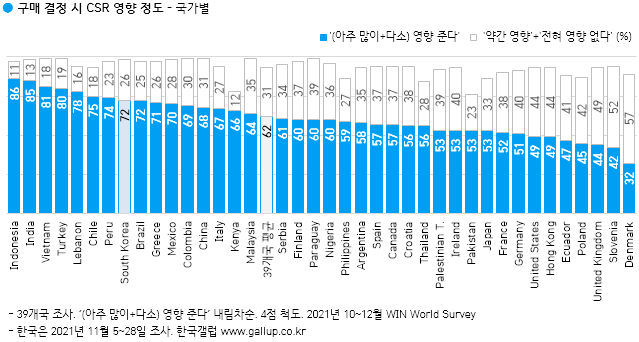
- 구매 결정 시 기업/브랜드 CSR 영향 62%
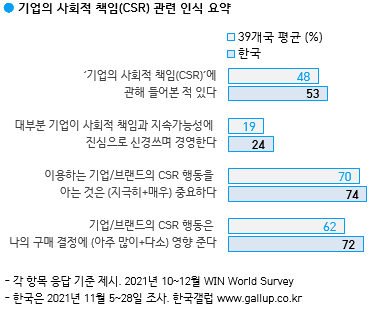
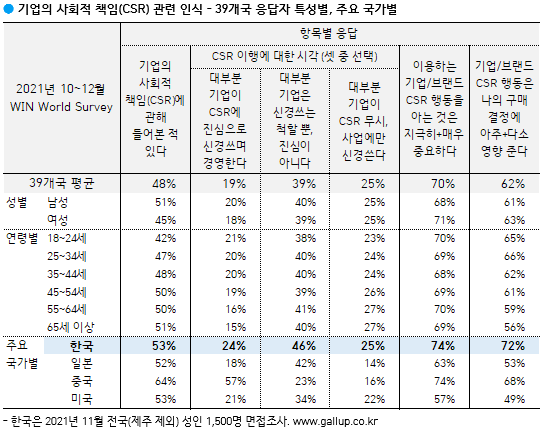
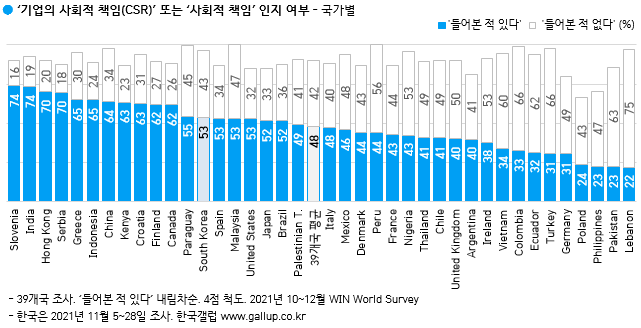
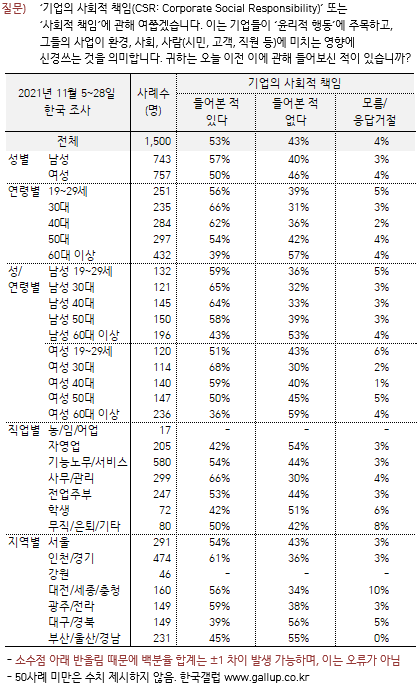
글로벌 조사 네트워크 WIN이 2021년 10~12월 39개국 성인 33,236명에게 '기업의 사회적 책임(이하 'CSR: Corporate Social Responsiblity') 개념 인지 여부를 물었다. CSR에는 다양한 정의가 있겠으나, 이 조사에서는 기업들이 '윤리적 행동'에 주목하고 그들의 사업이 환경·사회·사람(시민, 고객, 직원 등)에게 미치는 영향에 신경쓰는 것으로 부연했다. 그 결과 48%가 '들어본 적 있다', 42%는 '들어본 적 없다'고 답했다. CSR 인지도는 고학력자 또는 정규직 종사자, 그리고 유럽과 APAC(Asia-Pacific) 국가들에서 상대적으로 높은 편이며, 성별·연령별 차이는 두드러지지 않았다.
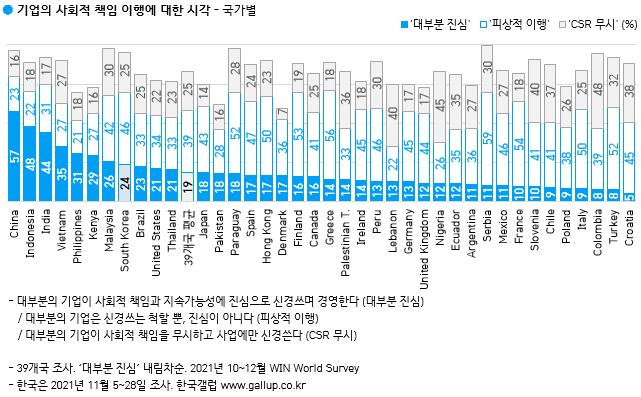
◎ 39개국 시민 상당수는 현재 기업들의 CSR 활동에 진정성을 느끼지 못하는 것으로 보인다. CRS 이행에 관한 세 가지 주장에서 '대부분의 기업이 사회적 책임과 지속가능성에 진심으로 신경쓰며 경영한다'는 데 동의하는 사람은 19%에 그쳤다. 39%는 '신경쓰는 척할 뿐, 진심이 아니다', 25%는 '사회적 책임을 무시하고 사업에만 신경쓴다'고 봤다. 국가별로 봐도 전반적으로 기업들의 CSR 활동에 부정적 시각이 지배적이지만, 중국과 인도네시아는 예외다. 중국은 정부 주도하에 기업 CSR 추진 중이며, 인도네시아는 세계 최초로 CSR을 의무화한 곳이다.
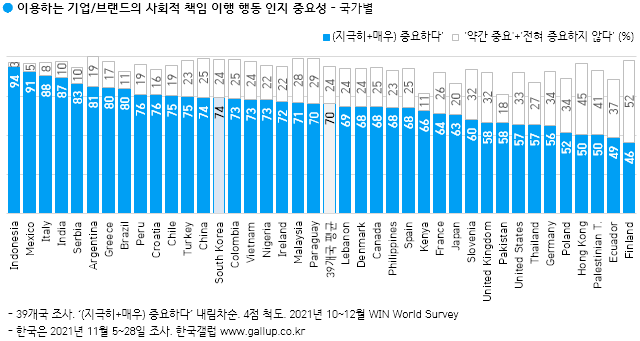
◎ CSR을 추구하는 기업들은 그 노력을 지속함과 동시에 널리 알리는 데도 신경써야 할 것으로 보인다. 39개국 시민 70%가 '이용하는 기업/브랜드의 CSR 활동을 아는 것이 중요하다'고 보며, 62%는 '기업/브랜드의 CSR이 자신의 구매 결정에 영향을 준다'고 답했다. 앞서 공개한 기후변화 관련 인식 조사에서도 지속가능성을 위한 기업 노력 필요성, 환경을 배려한 제품에 추가 비용 지불 등에 39개국 시민 약 70%가 동의했다(→ G20220209).
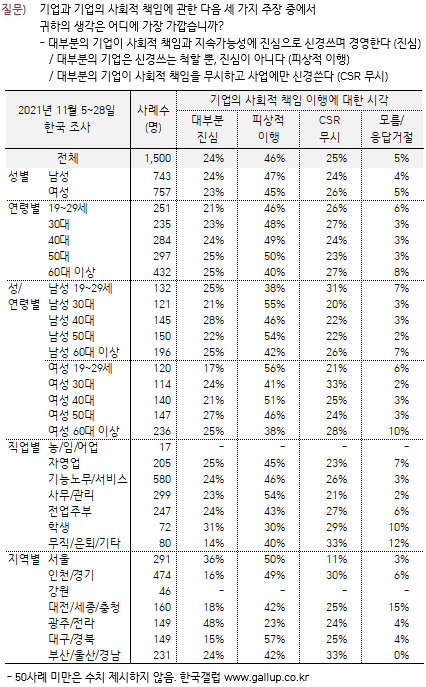
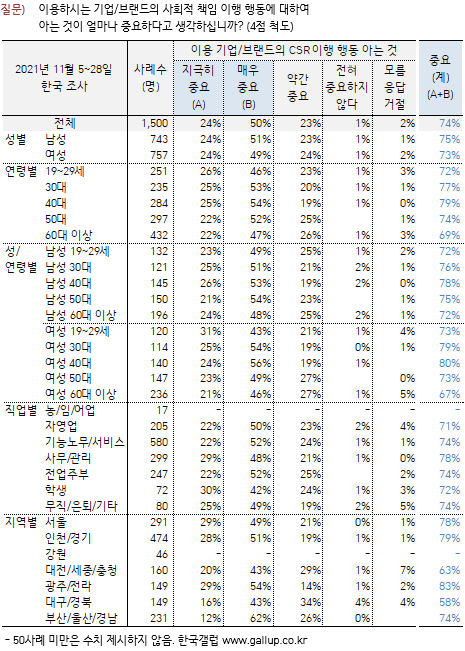
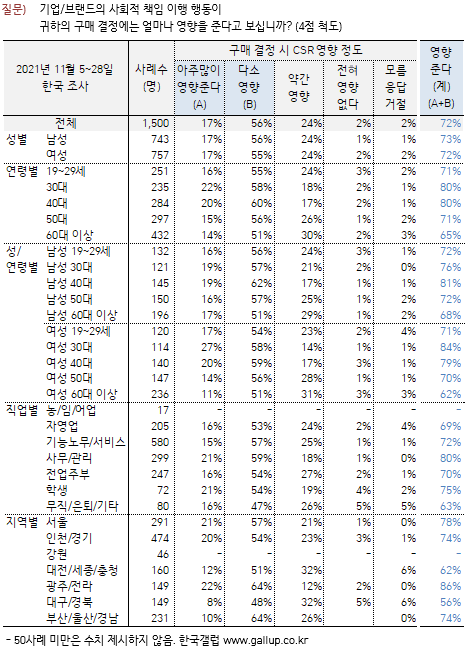
◎ 한국 조사는 2021년 11월 5~28일 전국(제주 제외) 성인 1,500명을 대상으로 했다. 한국인의 CSR 인지도(53%), 이용하는 기업/브랜드의 CSR 활동 인지 중요성(74%), 구매 결정 시 CSR 영향(72%) 등은 모두 39개국 평균을 웃돌았다. 기업 CSR 활동에 대해서는 절반가량(46%)이 '피상적'이라고 평가, 25%는 '대부분 기업이 CSR를 무시한다'고 답했다. 24%는 현행 기업 CSR 활동을 긍정적으로 봤다.
__
CSR 인지 여부
__
CSR 이행에 대한 시각
__
이용하는 기업/브랜드의 CSR 이행 인지 중요성
__
구매 결정 시 CSR 영향 정도
──────────────────────
Corporate Social Responsibility
and the Influence on Purchase Decisions
──────────────────────
WIN International, the world’s leading association in market research and polling has published the Annual Win World Survey (WWS – 2021) exploring the views and beliefs of 33236 individuals among citizens from 39 countries across the globe about Corporate Social Responsibility, what do people know about this concept, its importance and influence on their daily purchases.
General knowledge about CSR
The awareness about Corporative Social Responsibility among interviewed people was equally distributed between positive and negative answers: while 48% already heard about the concept, 42% of the group did not; 10% didn’t answer the question or didn’t know.
Even when looking at age groups and gender, data are equally distributed between those who know about CSR and those who don’t, while some differences can be found when looking at global regions. On one hand, in Europe and APAC there are more people who are aware of the concept than people who are not. In America as well, but the difference is of less than one percent. On the other hand, respondents in MENA region are less aware about CSR, with 60% of people not knowing what CSR stands for over 35% who do know.
Across the world, the higher the level of education, the more people know about Corporate Social Responsibility. When it comes to employment, people who work full time, students and retired people tend to know more about CSR, while part – time workers and unemployed or housewives are less aware about the concept.
Efforts to embrace and promote CSR
When thinking about the real efforts to embrace and promote CSR, 39% tends to believe that companies are not seriously doing it, and that the actions in place are only made for appearance, followed by 25% who believes most companies do not care at all about CSR. Results highlight how negative the opinions towards the efforts put in place by companies are, with the majority of people affirming that corporates seem to have little interest in sustainability and eco – friendly habits. However, there is also a share of people who tend to be more optimistic: 19% say most companies are seriously operating with corporate social responsibility and sustainability, a share that reaches 31% in APAC region. Most critical opinions can be found in Europe, where 48% say companies only talk about CSR for appearance (+9% than global average) and MENA, where 35% say companies do not care at all (+10% compared to global average).
Among higher educated people there are more respondents believing that companies are seriously operating with CSR, but the conviction that ‘it is only appearance’ still prevails.
Within the countries that were included in the present research, the option “most companies are seriously operating with CSR and sustainability” got its highest percentages in APAC countries. Nevertheless, the opinions about companies being careless about CSR are the ones that predominate almost in every country.
The importance of being aware of actions taken by companies/brands
When asked about the importance of being aware of the socially responsible behaviors of companies/brands that they are customers of, most people (70%) consider it important, while only 24% do not think it is relevant . When looking at occupations, the ones that are more conscious about the importance of being aware of the actions undertaken by companies are students, full-time workers and retired people. In addition, the higher education level, the more important being aware of CSR practices is.
The influence of CSR
Finally, the results related to the influence of Corporate Social Responsibility on purchase decisions provide some more interesting insights: on a global level, 62% say socially responsible behaviors of companies influences their purchase decisions, while 31% say they do not , meaning that people are increasingly more paying attention to companies’ ethical conducts and social role.
Results reflect the same distribution when comparing data between regions and gender, while an indirect relationship can be found when looking at age: older people tend to be less influenced by CSR and companies’ ethical conducts when it comes to their purchases.
Vilma Scarpino, President of WIN International Association, said:
“Corporate Social Responsibility is an increasingly more important subject, which however is not widely known yet: indeed, there is still a large share of the population who does not know what CSR stands for, which means that efforts in terms of communication and awareness need to be undertaken. Respondents are also skeptical about companies’ commitment to sustainable goals, which stresses ones again the need for companies to increase awareness on one hand, and trust and transparency on the other.
On the other hand, individuals not only believe that being aware of companies’ CSR commitments is important for them as consumers, but they also believe a company’s conduct directly influences their purchase decisions."
_____
응답자 특성표
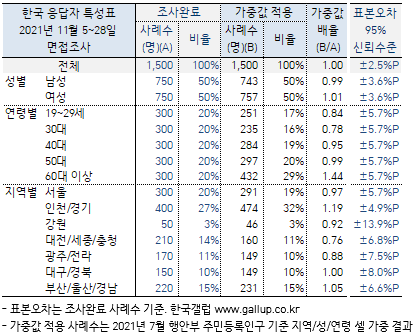
조사 결과는 행정안전부 주민등록인구 기준으로 가중 처리하여 최종 결과를 산출합니다. 아래 응답자 특성표의 조사완료 사례수는 실제 응답 완료한 인원, 가중값 적용 사례수는 2021년 7월 행정안전부 주민등록인구 기준 성/연령/지역별 셀 가중 처리 후 인원입니다.
| 전 대륙에서 시장조사와 여론조사를 하는 글로벌 네트워크 WIN(Worldwide Independent Network of Market Research)은 매년 말 건강, 환경, IT 등 여러 분야 현안에 관해 다국가 조사를 하고 있습니다. 2021년 10~12월 조사에는 39개국이 참여했습니다. 앞서 공개한 〈기후변화와 지속가능성〉 〈성평등(Gender Equality)〉 주제에 이어 오늘은 〈기업의 사회적 책임〉 관련 인식을 전합니다. |
기업의 사회적 책임(CSR) 관련 인식 - WIN 다국가 조사
→ 한국+세계 조사 결과 파일 다운로드(PDF)
/ 세계 조사 개요
2021년 10~12월 39개국 성인 총 33,236명 전화/온라인/면접조사(주제별 참여국 상이)
/ 한국 조사 개요
- 조사기간: 2021년 11월 5~28일
- 표본추출: 층화 집락 확률 비례 추출
- 응답방식: 면접조사원 인터뷰
- 조사대상: 전국(제주 제외) 만 19세 이상 1,500명
- 표본오차: ±2.5%포인트(95% 신뢰수준)
- 응답률: 28%(총 접촉 5,394명 중 1,500명 응답 완료)
- 의뢰처: 한국갤럽-WIN 자체 조사
/ 조사 항목
- '기업의 사회적 책임(CSR)' 인지 여부
- 기업의 CSR 이행에 대한 시각
- 이용하는 기업/브랜드의 CSR 활동 인지 중요성
- 구매 결정 시 CSR 영향 정도
(※ 세계 조사 상세 결과는 첨부 파일 참조)
조사 결과
2021년 10~12월 39개국 성인 절반, '기업의 사회적 책임(CSR)' 인지
- 시민 상당수, 기업 CSR 진정성 의심: '피상적' 39%, '무시' 25%
- 이용하는 기업/브랜드 CSR 활동 인지 중요 70%
- 구매 결정 시 기업/브랜드 CSR 영향 62%
글로벌 조사 네트워크 WIN이 2021년 10~12월 39개국 성인 33,236명에게 '기업의 사회적 책임(이하 'CSR: Corporate Social Responsiblity') 개념 인지 여부를 물었다. CSR에는 다양한 정의가 있겠으나, 이 조사에서는 기업들이 '윤리적 행동'에 주목하고 그들의 사업이 환경·사회·사람(시민, 고객, 직원 등)에게 미치는 영향에 신경쓰는 것으로 부연했다. 그 결과 48%가 '들어본 적 있다', 42%는 '들어본 적 없다'고 답했다. CSR 인지도는 고학력자 또는 정규직 종사자, 그리고 유럽과 APAC(Asia-Pacific) 국가들에서 상대적으로 높은 편이며, 성별·연령별 차이는 두드러지지 않았다.
◎ 39개국 시민 상당수는 현재 기업들의 CSR 활동에 진정성을 느끼지 못하는 것으로 보인다. CRS 이행에 관한 세 가지 주장에서 '대부분의 기업이 사회적 책임과 지속가능성에 진심으로 신경쓰며 경영한다'는 데 동의하는 사람은 19%에 그쳤다. 39%는 '신경쓰는 척할 뿐, 진심이 아니다', 25%는 '사회적 책임을 무시하고 사업에만 신경쓴다'고 봤다. 국가별로 봐도 전반적으로 기업들의 CSR 활동에 부정적 시각이 지배적이지만, 중국과 인도네시아는 예외다. 중국은 정부 주도하에 기업 CSR 추진 중이며, 인도네시아는 세계 최초로 CSR을 의무화한 곳이다.
◎ CSR을 추구하는 기업들은 그 노력을 지속함과 동시에 널리 알리는 데도 신경써야 할 것으로 보인다. 39개국 시민 70%가 '이용하는 기업/브랜드의 CSR 활동을 아는 것이 중요하다'고 보며, 62%는 '기업/브랜드의 CSR이 자신의 구매 결정에 영향을 준다'고 답했다. 앞서 공개한 기후변화 관련 인식 조사에서도 지속가능성을 위한 기업 노력 필요성, 환경을 배려한 제품에 추가 비용 지불 등에 39개국 시민 약 70%가 동의했다(→ G20220209).
◎ 한국 조사는 2021년 11월 5~28일 전국(제주 제외) 성인 1,500명을 대상으로 했다. 한국인의 CSR 인지도(53%), 이용하는 기업/브랜드의 CSR 활동 인지 중요성(74%), 구매 결정 시 CSR 영향(72%) 등은 모두 39개국 평균을 웃돌았다. 기업 CSR 활동에 대해서는 절반가량(46%)이 '피상적'이라고 평가, 25%는 '대부분 기업이 CSR를 무시한다'고 답했다. 24%는 현행 기업 CSR 활동을 긍정적으로 봤다.
__
CSR 인지 여부
__
CSR 이행에 대한 시각
__
이용하는 기업/브랜드의 CSR 이행 인지 중요성
__
구매 결정 시 CSR 영향 정도
──────────────────────
Corporate Social Responsibility
and the Influence on Purchase Decisions
──────────────────────
WIN International, the world’s leading association in market research and polling has published the Annual Win World Survey (WWS – 2021) exploring the views and beliefs of 33236 individuals among citizens from 39 countries across the globe about Corporate Social Responsibility, what do people know about this concept, its importance and influence on their daily purchases.
General knowledge about CSR
The awareness about Corporative Social Responsibility among interviewed people was equally distributed between positive and negative answers: while 48% already heard about the concept, 42% of the group did not; 10% didn’t answer the question or didn’t know.
Even when looking at age groups and gender, data are equally distributed between those who know about CSR and those who don’t, while some differences can be found when looking at global regions. On one hand, in Europe and APAC there are more people who are aware of the concept than people who are not. In America as well, but the difference is of less than one percent. On the other hand, respondents in MENA region are less aware about CSR, with 60% of people not knowing what CSR stands for over 35% who do know.
Across the world, the higher the level of education, the more people know about Corporate Social Responsibility. When it comes to employment, people who work full time, students and retired people tend to know more about CSR, while part – time workers and unemployed or housewives are less aware about the concept.
Efforts to embrace and promote CSR
When thinking about the real efforts to embrace and promote CSR, 39% tends to believe that companies are not seriously doing it, and that the actions in place are only made for appearance, followed by 25% who believes most companies do not care at all about CSR. Results highlight how negative the opinions towards the efforts put in place by companies are, with the majority of people affirming that corporates seem to have little interest in sustainability and eco – friendly habits. However, there is also a share of people who tend to be more optimistic: 19% say most companies are seriously operating with corporate social responsibility and sustainability, a share that reaches 31% in APAC region. Most critical opinions can be found in Europe, where 48% say companies only talk about CSR for appearance (+9% than global average) and MENA, where 35% say companies do not care at all (+10% compared to global average).
Among higher educated people there are more respondents believing that companies are seriously operating with CSR, but the conviction that ‘it is only appearance’ still prevails.
Within the countries that were included in the present research, the option “most companies are seriously operating with CSR and sustainability” got its highest percentages in APAC countries. Nevertheless, the opinions about companies being careless about CSR are the ones that predominate almost in every country.
The importance of being aware of actions taken by companies/brands
When asked about the importance of being aware of the socially responsible behaviors of companies/brands that they are customers of, most people (70%) consider it important, while only 24% do not think it is relevant . When looking at occupations, the ones that are more conscious about the importance of being aware of the actions undertaken by companies are students, full-time workers and retired people. In addition, the higher education level, the more important being aware of CSR practices is.
The influence of CSR
Finally, the results related to the influence of Corporate Social Responsibility on purchase decisions provide some more interesting insights: on a global level, 62% say socially responsible behaviors of companies influences their purchase decisions, while 31% say they do not , meaning that people are increasingly more paying attention to companies’ ethical conducts and social role.
Results reflect the same distribution when comparing data between regions and gender, while an indirect relationship can be found when looking at age: older people tend to be less influenced by CSR and companies’ ethical conducts when it comes to their purchases.
Vilma Scarpino, President of WIN International Association, said:
“Corporate Social Responsibility is an increasingly more important subject, which however is not widely known yet: indeed, there is still a large share of the population who does not know what CSR stands for, which means that efforts in terms of communication and awareness need to be undertaken. Respondents are also skeptical about companies’ commitment to sustainable goals, which stresses ones again the need for companies to increase awareness on one hand, and trust and transparency on the other.
On the other hand, individuals not only believe that being aware of companies’ CSR commitments is important for them as consumers, but they also believe a company’s conduct directly influences their purchase decisions."
_____
응답자 특성표
조사 결과는 행정안전부 주민등록인구 기준으로 가중 처리하여 최종 결과를 산출합니다. 아래 응답자 특성표의 조사완료 사례수는 실제 응답 완료한 인원, 가중값 적용 사례수는 2021년 7월 행정안전부 주민등록인구 기준 성/연령/지역별 셀 가중 처리 후 인원입니다.